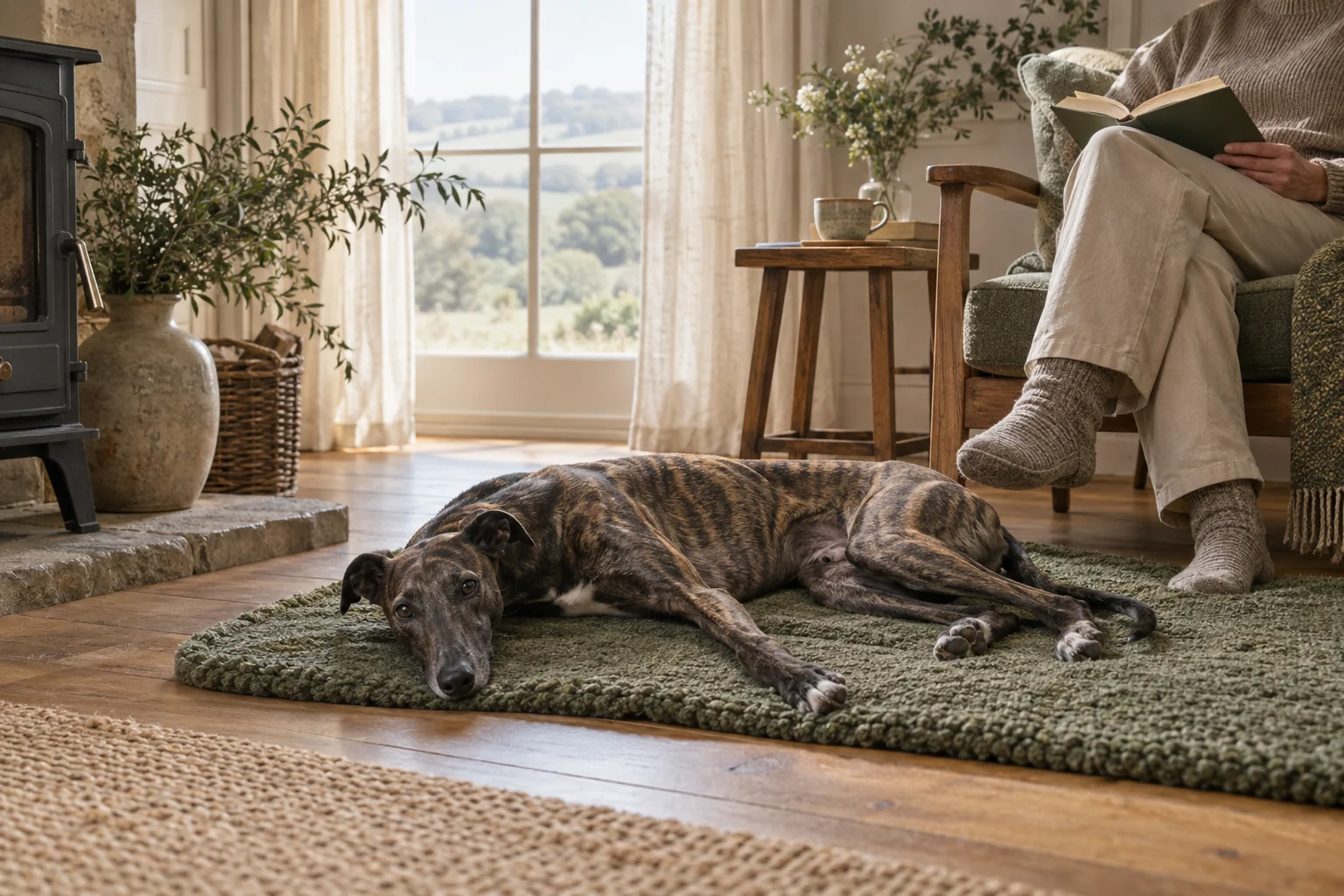
Good intentions are easier to act on when the practical details are already in place. Give yourself a minute to prepare before inviting your dog to participate.
Remove one unnecessary difficulty
Look at the space from your dog’s height. Is another pet waiting beside the treat pouch? Does the floor make standing comfortably difficult? Is the front window full of activity? You may not need a different exercise; you may need a different corner of the room.
Choose an area with space to move and a comfortable surface. Close access to hazards and give other animals their own appropriate space. Keep your dog free to pause or move away from a nonessential exercise.
Put the reward where you can reach it
Prepare small rewards suitable for your dog and account for them in daily feeding. If your dog has dietary restrictions, ask your veterinarian what is appropriate. Keep food out of reach between repetitions, while making delivery easy for you.
Rehearse the movement without your dog: notice the moment, mark it if you use a marker, then deliver the reward. Digging through packaging while your dog waits can make an otherwise simple exercise confusing.
Decide what the first repetition looks like
Write or say the smallest useful version out loud. “One step on a loose lead in the hallway” gives you a clear start. “A whole walk without pulling” is a broader ambition, not the opening repetition.
Put any equipment nearby before starting. A timer can remind you to check in, but your dog’s comfort determines whether you continue. Use the marker guide for clearer reward timing and our session guide for choosing an endpoint.
Give finishing a place in the plan
After a few useful repetitions, put the equipment away and return to an ordinary activity. Leave a brief note about where to start next time. That makes the next session easier to prepare and avoids treating an open-ended exercise as a test your dog must eventually pass.
Walk through the space before inviting the dog
Begin from the place where you intend to stand or sit. Look at the floor, the route the dog will take and the objects within reach. Check whether you can deliver a reward without leaning awkwardly, blocking movement or stepping into a busy walkway.
Now look at the room as an activity map. A window may draw attention, a doorway may bring people through, and another animal may be waiting nearby. You do not have to remove every ordinary sound from the home. You do need an opening arrangement that matches the exercise you intend to teach.
For example, an attention lesson might be easier in a quiet corner than beside the front window. A mat exercise might fit beside a reading chair rather than in the route to the kitchen. The difference is not the size of the home; it is the practical role of that part of the room.
Choose a setup you can recreate. If it takes elaborate rearrangement every time, simplify it while preserving comfort and safety. A manageable preparation routine is more likely to survive an ordinary busy week.
Make the reward accessible without making the room chaotic
Prepare suitable rewards before the dog joins you. Decide where they will wait, how you will reach them and where you will deliver them. Keep stored food safely out of reach between repetitions, particularly when other animals are nearby.
Rehearse your own sequence once. Can you mark the chosen moment, reach for the reward and deliver it without searching, rustling packaging or changing position unexpectedly? If not, fix the human arrangement before adding the learning task.
A before-and-after example
In the first arrangement, the reward bag is behind the chair. Each delivery requires the handler to twist and stand, and the dog follows the movement away from the mat. In the revised arrangement, the reward is already accessible and the handler can remain seated. The exercise now asks fewer unrelated questions at once.
This is a fictional illustration, not a promise that moving a pouch resolves every difficulty. Its purpose is to show why reward delivery belongs in preparation. If reaching towards the dog causes concern, pause and obtain appropriate guidance rather than trying to make the same movement faster.
Prepare for other people, pets and interruptions
Tell the household what you are about to do and where. A brief agreement can prevent someone walking through the setup halfway through the first repetition. Other pets need an appropriate arrangement too, so they are not competing for rewards or crowding the dog.
Decide how to handle a likely interruption. If the doorbell rings, the lesson can stop. If someone needs the room, return to an ordinary activity and arrange another opportunity. You do not have to preserve the session at all costs.
- A person enters
- Notice whether the setting remains suitable. Simplify or stop instead of repeating the same request through a changed scene.
- Another pet approaches
- Pause and restore an appropriate arrangement before continuing.
- You need to answer a call
- Finish the exercise and make care or supervision responsibility clear.
The practical preparation includes the end of the session. Put equipment away safely and do not leave a puppy or another animal with access to items that were only appropriate under supervision. A clear finish makes the next ordinary part of the day easier to manage.
Use a preparation check that stays short enough to repeat
A long checklist can become another reason not to begin. Keep the routine focused on the details that affect the exercise you chose. The questions below are a starting framework, not a requirement to create a perfect room.
- Place: is the surface comfortable and the route clear?
- People and pets: does everyone have appropriate space?
- Reward: is it suitable and easy to deliver?
- Goal: can I name one visible response?
- Finish: do I know when and how to pause?
After the session, note which preparation choice actually helped. “Moved away from the window” is a repeatable action. If the room was still unsuitable, identify a different place or time rather than assuming the dog should cope with it.
Use the beginner field guide for a full preparation checklist and first exercises, or the short-session guide for planning the practice itself. The purpose of preparing the space is to make a small lesson clearer, then leave you free to pay attention to the dog.