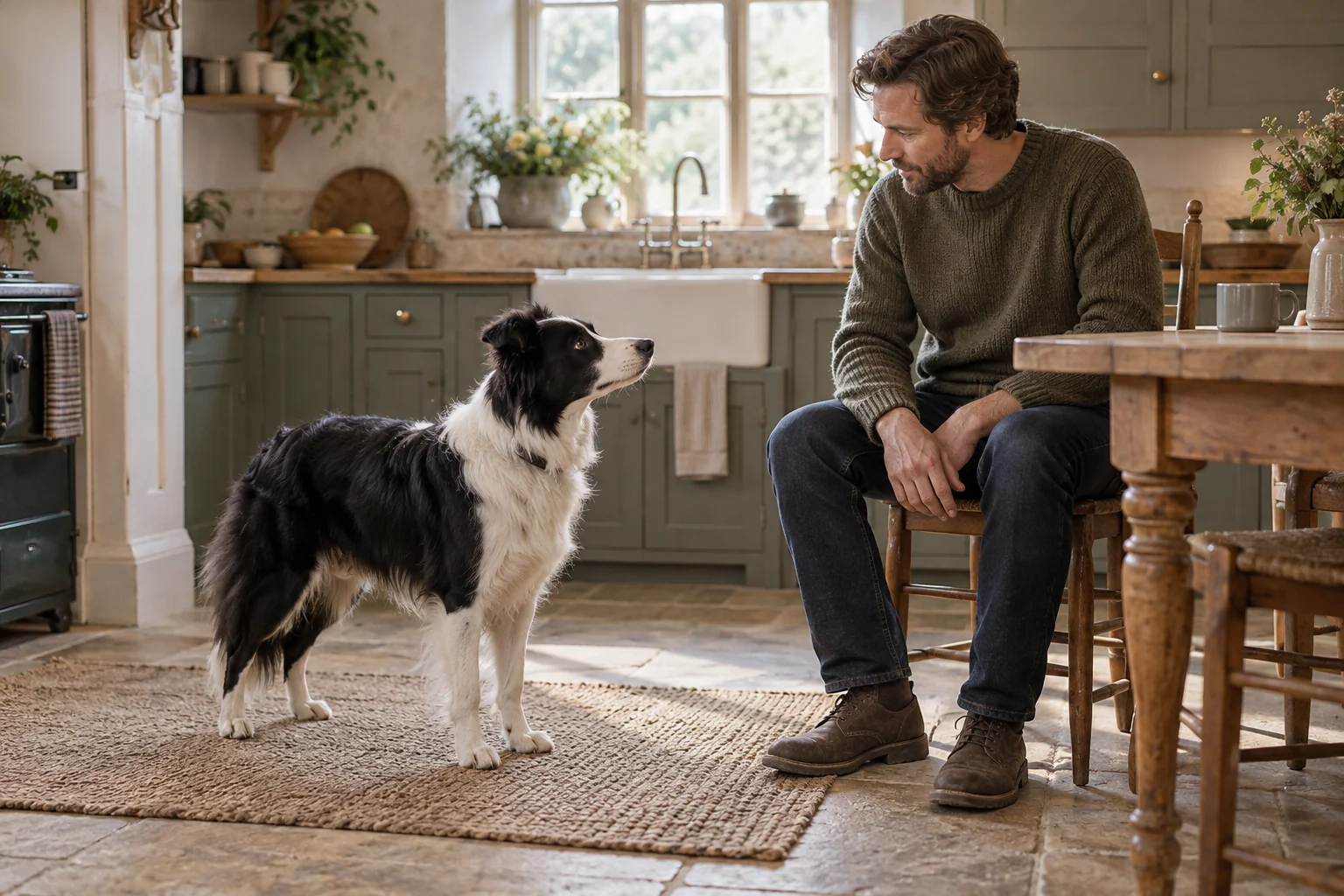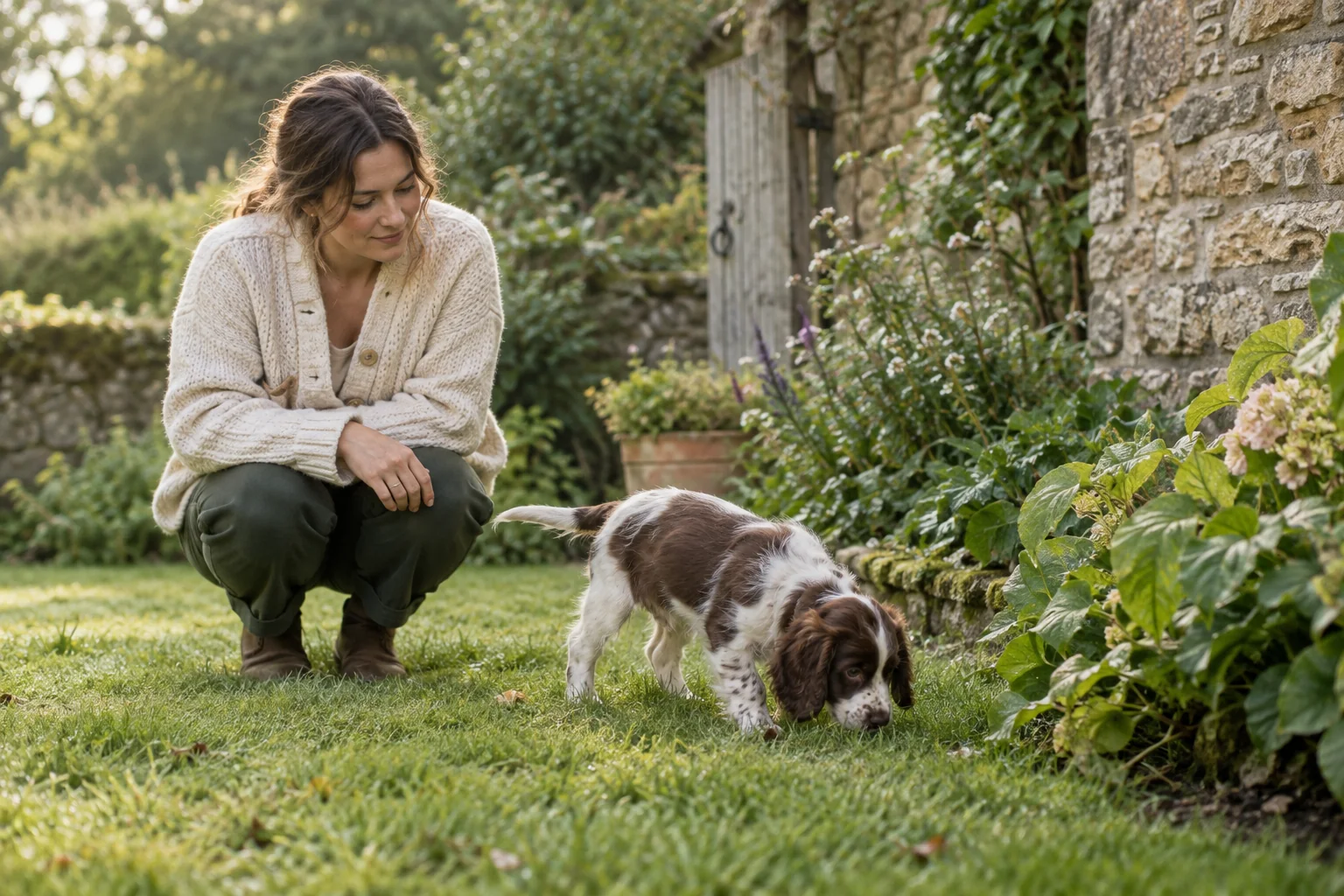
Your puppy’s first week is a change of home, familiar smells and daily rhythm. You do not need to fit a whole training course into it. Start by making the next few hours predictable, then repeat what helps.
Put it into practice
Your next awake moment with your puppy
Have the toilet route ready, a supervised space available and a resting place the household will leave undisturbed.
- Check care first. A puppy waking from a nap needs a toilet opportunity before a training game. Accompany them and notice what happens.
- Offer one easy interaction. Back in the prepared space, if your puppy is comfortable, say their name once from nearby. Reward a brief turn towards you.
- Leave a gap. Let your puppy return to exploring or resting. Another name response is optional; you do not need to fill every awake period with lessons.
What happens next?
- If there is no turn
- Avoid repeating the name while following your puppy around. Try at a quieter moment when you are closer and their attention is available.
- If they move away
- Give them space. Remove the lesson from the next busy period rather than adding more excitement to regain attention.
- Before handing over
- Tell the next caregiver what you saw on the toilet trip and who is supervising now. “Went outside” does not confirm that your puppy peed.
Choose a simple home base
Choose a comfortable resting area away from the busiest walkway. Put water within easy reach and puppy-proof the surrounding space. Give your puppy somewhere to retreat without visitors following them. A bed, pen or open crate can be part of that setup, provided it is introduced gently and your puppy is comfortable.
Agree on a few practical details before the household gets excited: which door leads to the toilet area, where rewards are kept, and who is watching the puppy next. A clear handover is more useful than assuming somebody else noticed the last nap.
Build the day around transitions
Offer toilet opportunities after waking, eating and play, as well as whenever your puppy’s behaviour suggests a need. Quietly accompany them to the chosen place. Reward after they finish, while you are still there. Clean accidents calmly; punishment does not explain where to go next time.
The RSPCA’s toilet-training guidance supports frequent opportunities and immediate rewards. Your puppy’s age, health and individual pattern matter more than a rigid timetable. For an example routine and household log, use our puppy potty training schedule.
“Woke at 10:20, went outside at 10:23, toileted at 10:25” gives tomorrow’s routine more direction than “another accident.”
Make the first lesson tiny
Wait until your puppy is awake, comfortable and curious. Say their name once in a quiet voice. If they turn towards you, offer a small suitable reward. Try just a few repetitions, with time to look around between them. You are building a pleasant association, not testing whether they can concentrate through a party.
Another starting point is to quietly reward a moment with all four paws on the floor. Choose one exercise, then stop. Our guide to reward markers explains how a short word can help make the successful moment clearer.
Introduce the world in small pieces
A new sound, a different surface or a calm visitor can be plenty for one encounter. Give your puppy room to observe and move away. Do not make greeting every person or dog the target. A short, comfortable experience is more useful than a long encounter your puppy struggles to escape.
Ask your veterinarian which outings are appropriate while vaccinations are in progress. The RSPCA’s puppy-care guidance discusses positive early experiences alongside veterinary care. Exposure should fit both local health risks and your puppy’s response.
Keep the plan flexible
Write down three priorities for the week: a workable toilet routine, a comfortable place to rest and one easy attention game. Add details only when those foundations feel manageable. If biting and zooming arrive after a busy afternoon, review the day’s demands and opportunities for rest before adding another lesson.
Keep a note of what helped today and what was too much. DogPath’s puppy guidance and potty log can hold that information, or you can use a notebook. When your puppy is ready for a quiet exercise, try the first step of mat training. There is no deadline for getting through the list.
Plan the first evening, not the whole first year
Before your puppy arrives, walk through an ordinary evening as if you were already caring for them. Where will you put your shoes while keeping the entrance secure? Can you reach the toilet area without searching for keys? Where can the puppy rest while someone prepares food? These practical questions turn a general intention to be consistent into a workable arrangement.
Write the next few responsibilities on one sheet: who accompanies the puppy outside, who supervises while dinner is made, and who handles the next waking period. The person taking over needs to know what actually happened, including an outing where no toileting was observed. Avoid marking a task complete merely because somebody opened the garden door.
A first-evening example
A puppy wakes while one person is cooking. The other person takes them to the agreed toilet spot, stays nearby and records the outcome. Back indoors, the puppy has a quiet, supervised opportunity to explore a small prepared area. A visitor who wants to meet the puppy waits until a more suitable moment. The household has protected care and rest without needing to introduce a new command.
If the evening goes differently, change the plan. A puppy who is unsettled needs a response to what is happening now, not pressure to follow the schedule you wrote earlier.
Introduce one new experience without rushing the next step
Choose one ordinary experience you want your puppy to become comfortable with: a quiet visitor, a household object or a different safe surface. Decide how you can make it smaller before you begin. A visitor can sit farther away; an object can remain still; a puppy can look at a surface without being placed on it.
Worked example · A visitor in the kitchen
Set up: the visitor sits to one side, leaves the doorway clear and lets the puppy choose where to go.
Observe: the puppy looks, moves away and returns to sniffing the room. Nobody needs to call them over for the visit to be useful.
Adjust: if the visitor reaches out and the puppy backs away, stop the reaching. Return to quiet observation with more space.
Make the next experience smaller, not simply shorter
A brief encounter can still be too intense. Change the part that caused difficulty: movement, closeness, sound or the number of people involved. Ending after a few seconds does not make a crowded greeting appropriate.
Keep a two-column note: what was present and what the puppy did. “One seated visitor; puppy explored the opposite side of the room” gives you a starting point for next time. “Met a person” tells you little about how it felt.
Rest between experiences and let familiar, uneventful moments fill most of the day. For outdoor locations and contact with other dogs, follow your veterinarian’s advice about your puppy’s health and vaccination situation. The RSPCA puppy-care guide explains the role of positive early experiences alongside veterinary care.
Make greetings and handling easier to understand
Excited people can make a simple meeting surprisingly complicated. Ask a visitor to wait while you prepare the space. Give your puppy the choice to approach without being called by several people at once. If they remain at a distance, the visit can continue without making contact the objective. A quiet observation is still an experience.
For ordinary care, break your own actions into small parts. Let your puppy see a brush before expecting a full grooming session. Arrange a comfortable position before touching a paw. Pause if they withdraw or become uneasy; completing the human task is not the only useful outcome. For care that cannot safely wait, ask your veterinary team how to proceed.
Keep a record of the setup
“Looked at the brush on the floor, then returned to exploring” describes what happened. “Grooming sorted” does not. The next person can begin with the same easy arrangement instead of assuming the puppy is ready for several minutes of handling.
Children need active adult supervision around the puppy. Give both child and puppy clear space to disengage, and protect sleeping, eating and resting periods. Do not turn the first week into a series of demonstrations for everyone who visits.
Review three common first-week situations
The puppy becomes busier when you start a lesson
Look at the events immediately before it. Perhaps there was a visitor, a game and an outing before you picked up the rewards. Remove the lesson from that crowded sequence. At the next suitable moment, try just one easy response in the usual quiet space. You are changing the demands of the situation rather than assigning a label to the puppy.
Two people use different words
Choose one cue for the exercise you are currently teaching and describe the action it means. A short household note might say: “Say the name once; reward a turn towards you; finish after a few easy turns.” Other skills can wait until this one has a shared explanation.
The routine works on weekdays but not at weekends
Map the transitions that still happen even when the clock changes: waking, meals, play and care handovers. Attach the practical plan to those events. Agree who is responsible before everyone assumes somebody else is supervising.
At the end of the week, keep what was useful and change one bottleneck. A clearer handover or a quieter resting place can be a more valuable next step than adding another cue. Seek individual help when your puppy’s health, comfort or behaviour concerns you.
Common questions
What should I teach my puppy first?
Begin with a nearby name response after care needs have been met: say the name once, reward a brief turn towards you and pause. Keep toilet opportunities and rest predictable throughout the day. You do not need to teach sit, stay and recall together in the first week.
Should I follow a strict puppy training schedule?
Use meals, waking and play as planning points, then adjust to what your puppy actually needs. A written handover helps the household coordinate. A timetable should not make a puppy wait when they need to go out.
Should everyone train the puppy on the first day?
The household can share care without each person introducing a lesson. Agree on the same simple response and reward arrangement first. Give the puppy time between interactions, and let an adult coordinate visitors, children and other pets.
What if we missed a day of practice?
Return to the last comfortable exercise when there is a suitable opportunity. You do not need to catch up by doubling the next session. Review why the day was difficult and adjust the plan so care remains manageable.
Does socialisation mean meeting every dog?
No. The aim is a comfortable introduction to the world, not a quota of greetings. Space to observe and move away matters. Ask your veterinarian about appropriate contact and settings for your puppy’s vaccination stage and local risks.
How do I decide what to practise in week two?
Use the first week’s observations. If the toilet handover remains unclear, improve that. If a quiet name response feels easy, repeat it in a similarly manageable situation. Choose the next useful step from what you observed, rather than from an age-based checklist.
General training education for comfortable, everyday practice. Pain, sudden behaviour changes, panic, aggression or bite concerns need veterinary or qualified in-person behaviour support.