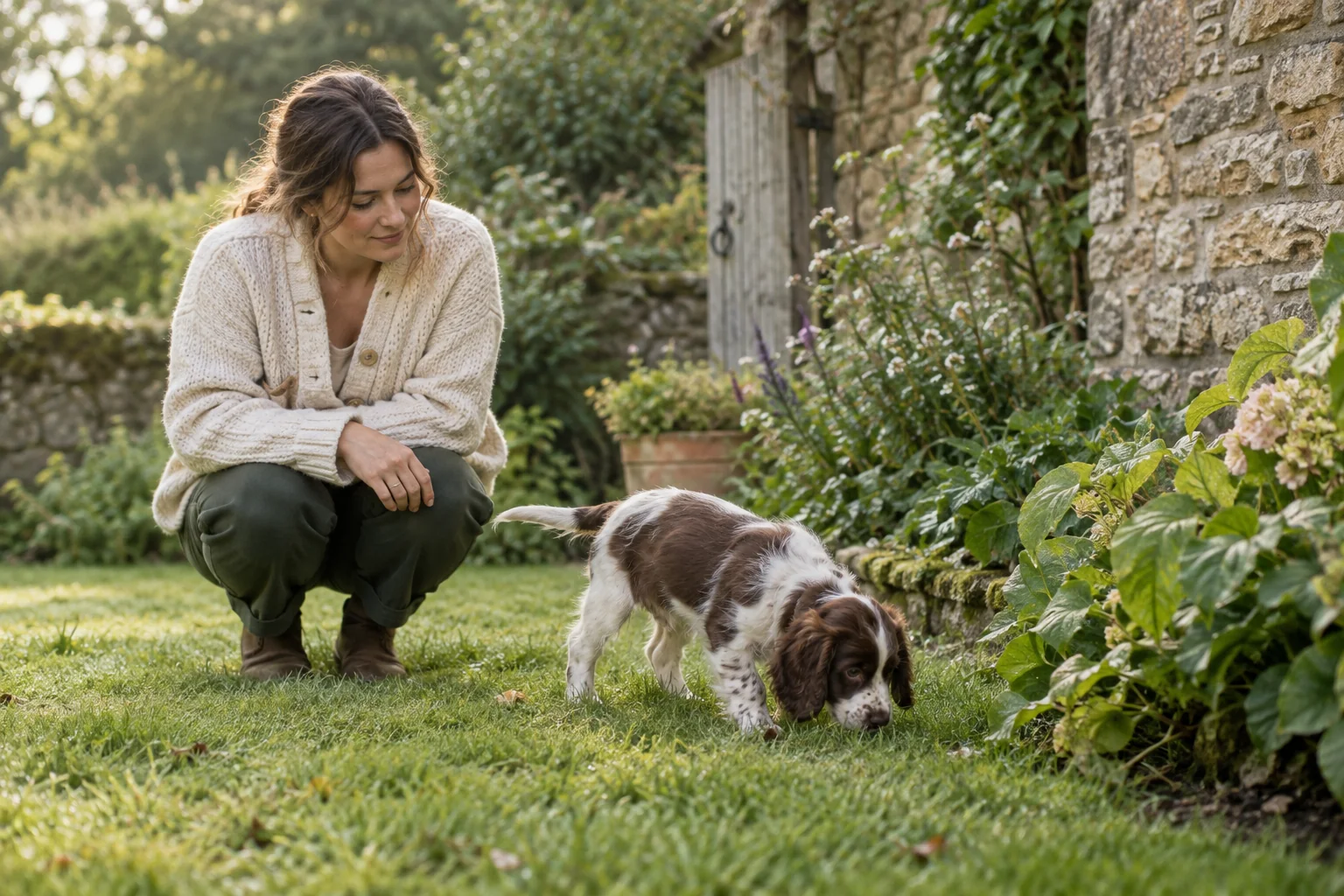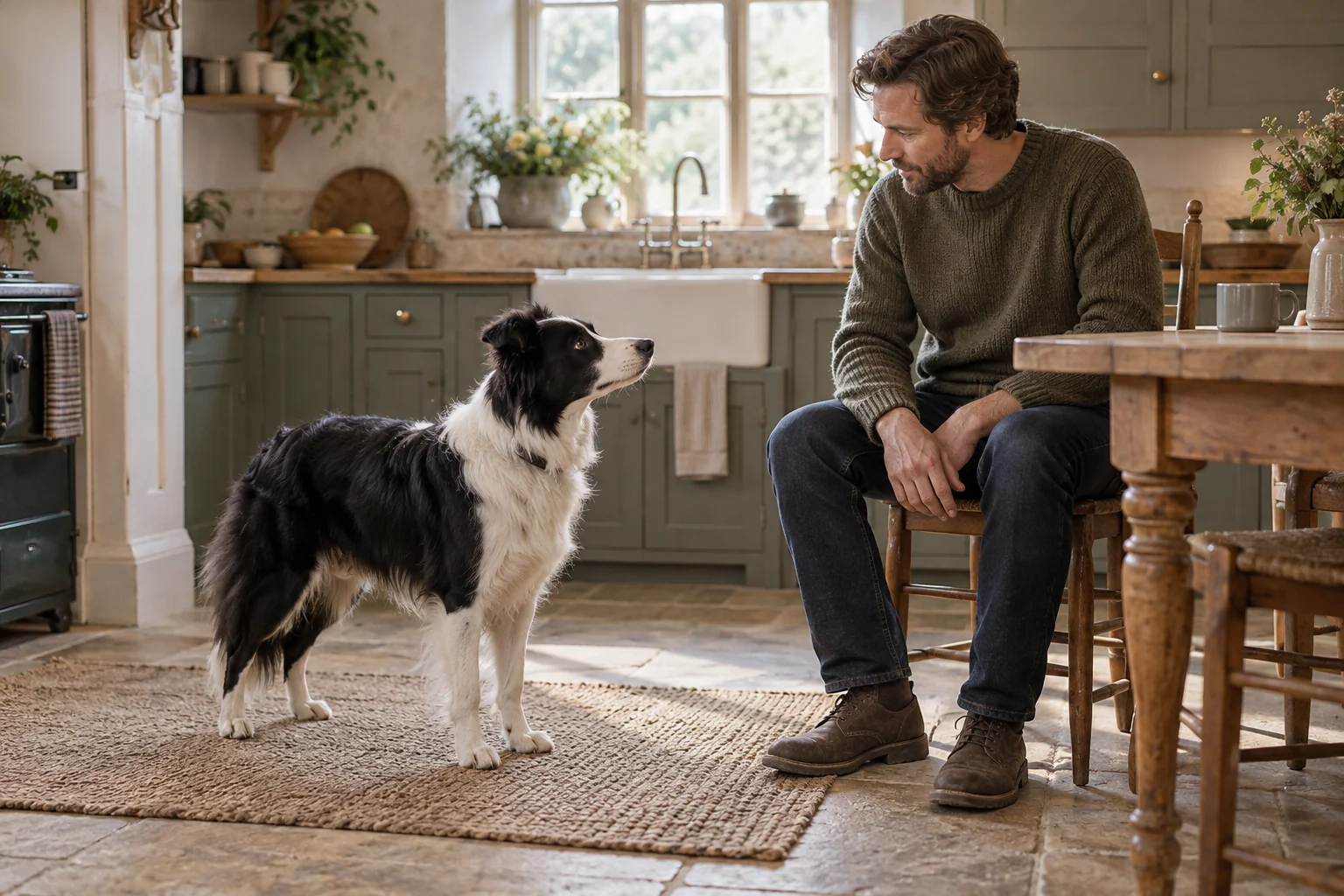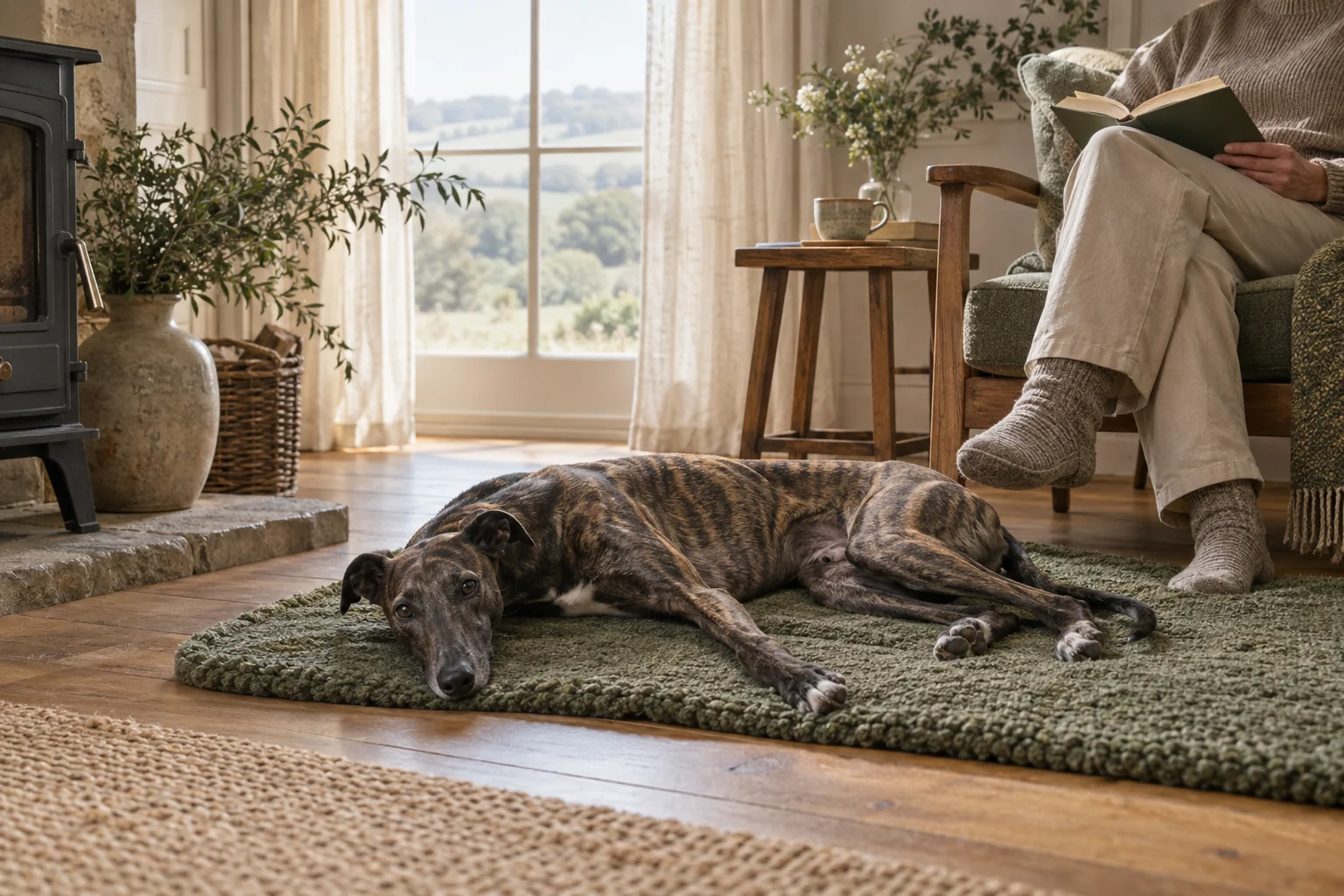
A mat can give relaxation a familiar setting. The aim is a dog who feels comfortable resting there, rather than a dog holding a tense position while waiting for the next instruction.
Put it into practice
Start with a mat your dog can choose
Put a comfortable, non-slip mat near your chair in a quiet room. Meet ordinary care needs first and leave a clear route off the mat.
- Wait for an approach. Quietly reward a voluntary look, step towards the mat or paw on it. Start with the smallest interaction your dog offers.
- Keep delivery low and quiet. Place the reward on the mat when practical, without drawing your dog into a jump or calling them away.
- Notice the whole posture. As the mat becomes familiar, watch for easier resting: a weight shift, softer body or head lowering. Reward quietly without insisting on a long stay.
What happens next?
- Your dog steps off
- Let them leave. Next time shorten the pause or undo the last change, such as standing from your chair.
- Your dog lies down but watches every movement
- Keep the surroundings quiet and your own movements small. Elbows on the floor alone do not show that the dog is relaxed.
- The quiet version is familiar
- Try one small movement, such as turning a page, while keeping the room and duration the same. Leave guests and cafés for a later stage.
Choose a place where rest makes sense
Use a non-slip mat or comfortable bed in a quiet part of the room. Start when your dog has had a chance to toilet and their everyday needs have been met. Keep other pets and excited visitors out of the setup at first.
Sit nearby with small suitable rewards ready. Leave your dog room to approach and leave. If the bed is beside a noisy appliance or in a busy doorway, moving it may help more than repeating an instruction. Do not use restraint to make an uncomfortable dog remain there.
Notice the earliest easy choice
At first, you might reward looking at the mat, moving towards it or placing a paw on it. Place the reward on the mat when practical, so the location becomes part of the experience. Allow time between rewards instead of asking for a rapid sequence of positions.
When standing on the mat is easy, watch for a voluntary sit, a shift of weight or lying down. The next criterion should match the dog you see, not an ideal version of the exercise. If your dog keeps bouncing up, slow down and reduce the excitement of your delivery.
Look for comfort, not just stillness
A dog can lie down while remaining alert and ready to spring up. Over time, notice softer posture, a hip shifting to one side or a head resting. Quietly reward those moments. Avoid interpreting any single body signal in isolation; look at the whole dog and the situation.
Dogs Trust’s settle guidance also recommends beginning in a quiet setting and progressively rewarding relaxed behaviour. Keep this first version undemanding before expecting it to transfer to a café.
“Stayed on the mat while I sat down” is a useful note. “Was calm” leaves you guessing which part of the setup helped.
Increase time gently
Once your dog is comfortably resting, allow a small additional pause before the next reward. Keep several repetitions easy. If they leave, let the moment reset; do not drag them back or scold them for getting up.
Look at why the exercise changed. Did you suddenly stand? Was the gap between rewards much longer? Did another dog enter? Rebuild the familiar version first. You can use the simple planning method in our short-session guide to choose just one change next time.
Move the skill into everyday life
Try the same mat in another quiet room before a busy public place. When adding your own movement, start with something small, such as shifting in the chair. Carry on with ordinary calm activities rather than turning each session into a long test.
A settling exercise does not treat separation distress. If your dog panics when you leave, cannot relax despite having their needs met, or shows a sudden change in behaviour, contact your veterinarian and an appropriately qualified behaviour professional. The DogPath practice programs can organise ordinary training, but cannot diagnose the reason a dog is distressed.
Choose between teaching the mat and noticing natural rest
There are two useful starting situations. In one, your dog already chooses to rest near you and you want to make a particular mat part of that setting. In the other, the mat itself is unfamiliar and the first lesson is simply a comfortable approach. Decide which situation describes the dog in front of you.
If your dog is already resting, keep your movements quiet and avoid turning every pause into a request for attention. If the mat is new, place it where your dog has room to investigate without being blocked or crowded. A thick bed, a flat mat and a blanket may feel very different; notice whether the surface is comfortable for your individual dog.
Write a starting criterion you can see
“Walks onto the mat voluntarily” and “rests their head while I remain seated” are different criteria. Start with the one that is appropriate now. Do not require the full picture of a sleeping dog during the first introduction.
The original scene might be very small: you sit beside a prepared resting space with a book, and your dog briefly stands on the mat. That can be enough information to decide where the next session should begin.
Reward rest without restarting the whole game
Before sitting down, place suitable rewards where you can reach them quietly. Choose a seat close enough to deliver without standing or leaning over your dog. If your dog is uncomfortable with hands near their resting place, pause this exercise and get individual guidance.
Watch what happens after the reward
A useful sequence preserves the resting position: your dog lowers their head, you place the reward within comfortable reach, then your hand returns to rest. Keep the next pause short enough for the current stage. Do not repeatedly call your dog back after each reward to rebuild the scene.
- Your dog gets up to reach your hand
- Check delivery position first. Bring the reward to a comfortable place on the mat instead of holding it above your knee.
- Your dog stays down but stares at the pouch
- Keep your hands still between rewards and reduce rustling or repeated reaching. Choose a quieter moment if the whole session has become an excited food game.
- Your dog leaves when you increase the gap
- Return to the shorter interval at the next suitable opportunity. Keep your own movement unchanged while practising time.
Two different goals
Mat approach: the dog walks onto the mat, receives a reward and steps off. That can be useful practice for choosing the location.
Resting: the dog remains comfortable while you sit quietly, with a softer body and occasional head rest. Reward delivery should preserve that setting.
Know which goal you are teaching today. A dog repeatedly hopping on and off the mat may understand an approach game without yet being ready to rest there. Keep approach lessons brief, and also protect ordinary undisturbed rest that involves no training at all.
Take the mat into ordinary life in stages
Keep the first version anchored to a familiar room and a quiet human activity. Then choose one small difference. Moving your hand to turn a page is a different challenge from standing up; standing is different from walking across the room. You can practise those changes separately.
- Same room, a tiny movement
- Shift in your chair and observe. If your dog remains comfortable, continue quietly.
- Same room, a different calm activity
- Try sitting with a laptop after the book setup is familiar. Keep the session easy.
- Another quiet room
- Bring the familiar mat and reduce expectations while the place changes.
- A busier destination
- Review space, noise, other dogs and the ability to leave before considering practice there.
This is a planning example, not a timetable. The mat does not make every destination suitable. A narrow café with dogs passing close by may offer less comfort than an ordinary room at home, regardless of how well the home exercise went.
Dogs Trust’s settling guidance describes beginning quietly and adding distractions gradually. Adapt the progression to what you observe instead of using a public outing to test the whole skill at once.
Understand what to change when the mat lesson stalls
Your dog leaves after each reward
Notice whether your delivery draws them away from the mat or whether you increased the pause too quickly. Return to a short, easy interaction. Leaving is useful information about the arrangement, not a reason to physically hold the dog on the bed.
Your dog stares at your hands
The exercise may currently be an active reward game. Simplify your movements, choose a quieter moment and look beyond the hand-watching position. Do not stretch the wait until frustration becomes the main event.
The mat gets chewed or dragged around
Pause and check whether the surface and activity are appropriate. If material could be swallowed, remove access safely and choose a suitable alternative. Training does not override the need to manage an unsafe item.
A comfortable dog suddenly avoids the bed
Check for changes in the location, surface or household activity and seek veterinary advice if discomfort or a sudden behaviour change is possible. Do not assume the solution is a stricter cue.
A useful end-of-session note identifies one change: “Moved the mat away from the doorway; next time keep the same place and stay seated.” That is easier to act on than “needs to settle for longer.”
Common questions
What if my dog keeps leaving the mat?
Check what happened just before they left. If you stood up, practise seated again. If you waited longer between rewards, return to the shorter pause. If reward delivery drew them off the mat, change its position. Let your dog leave instead of repeatedly putting them back.
Is lying down the same as being relaxed?
Not necessarily. Notice the whole posture and the surroundings. A dog who is rigid or constantly scanning may need more space and a quieter setting, even if their elbows are on the mat.
Should I add a “settle” cue straight away?
First establish an easy, comfortable pattern around the mat. If you later add a cue, connect it to a response your dog understands rather than repeating it while they are unsettled. The mat and surroundings are part of the learning context.
Can I use the mat when guests arrive?
Build the quiet version and modest household activity first. A real arrival can be much harder, so arrange space and management before visitors enter. Do not rely on an unfinished mat exercise to handle an interaction that may be unsafe.
Does mat training teach my dog to be home alone?
It can be an ordinary resting skill, but it does not establish comfort with separation. Distress when left needs its own assessment and plan. Avoid using a mat exercise as proof that your dog can cope with an absence.
Do I have to use a special training mat?
No particular brand is required. Choose a comfortable, stable surface appropriate for your dog and supervise its use. Its familiarity and location can be useful, but the material alone does not teach relaxation.
General training education for comfortable, everyday practice. Pain, sudden behaviour changes, panic, aggression or bite concerns need veterinary or qualified in-person behaviour support.