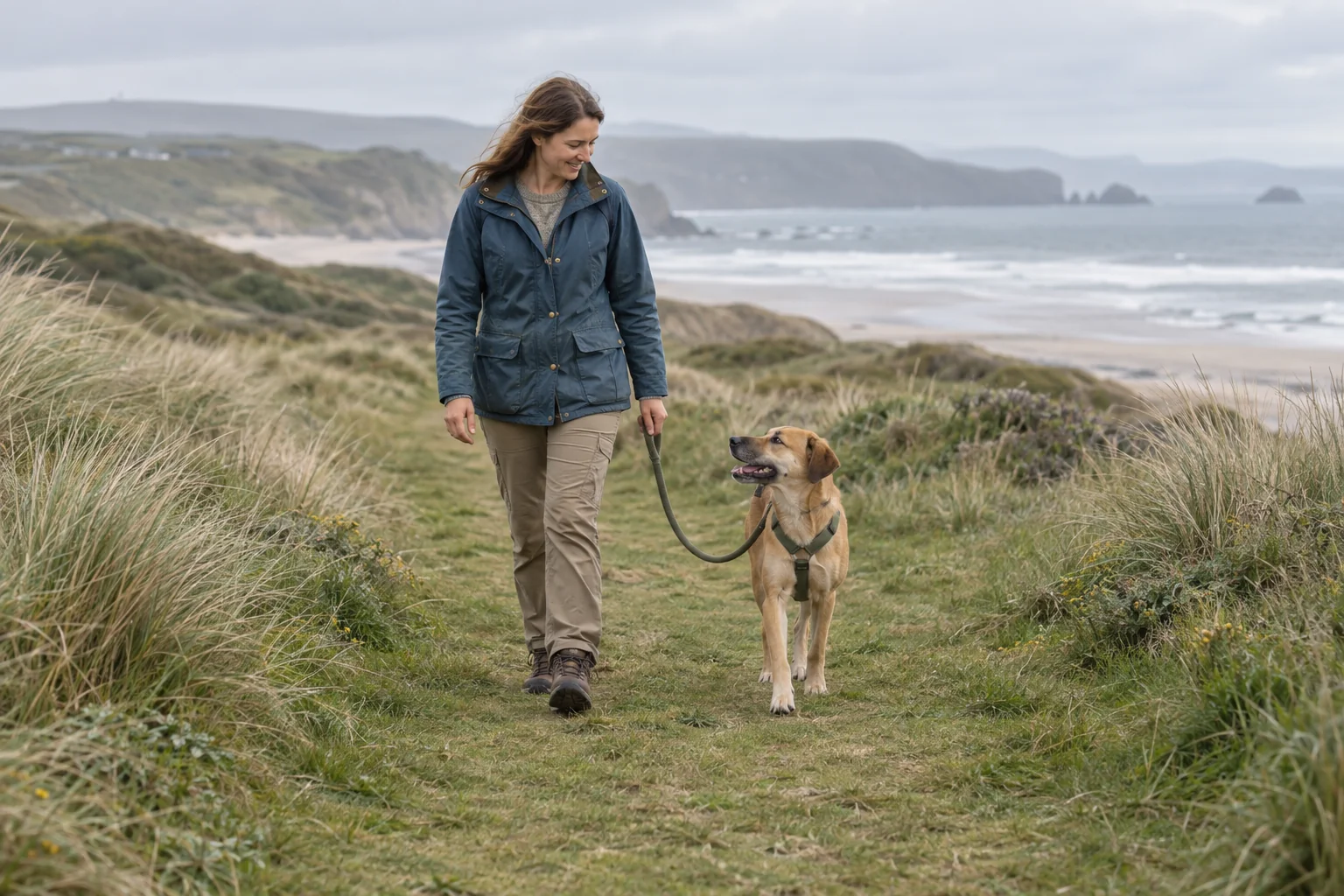
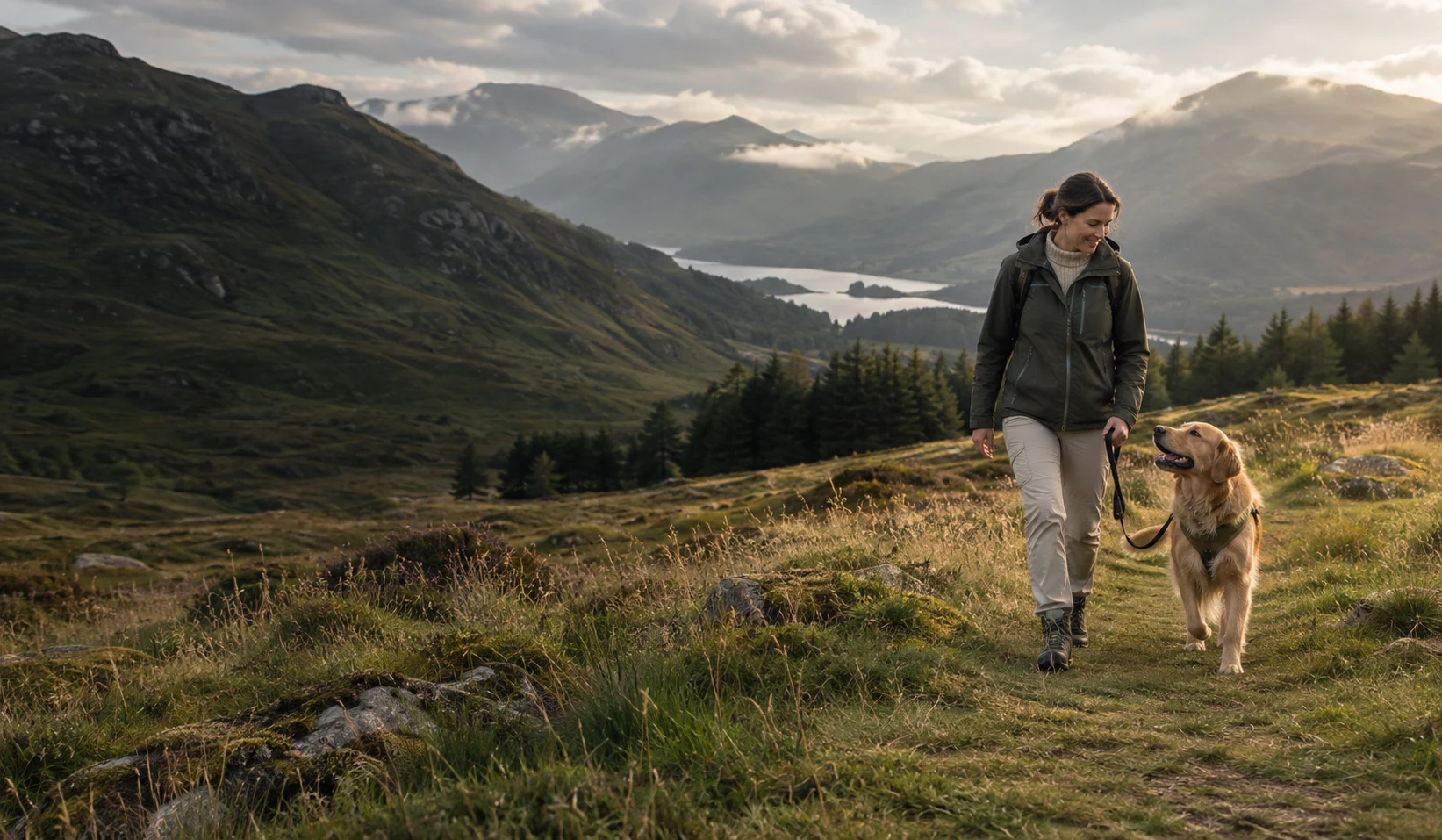
A woman and her golden retriever walking together on a grassy trail in the misty Highlands

Dog training
at home.

Start dog training at home with kind, practical exercises.
Better walks, puppy routines and calmer days, one small step at a time.

THE EVERYDAY
TRAINING JOURNAL
EXPLORE ↓
Reward-based, always Short dog training sessions Every dog belongsThe way we train

Dog training for beginners

How to train your dog
at home.

What would make today a little easier? Choose one part of everyday life. Find your setup here, then follow the full exercise further down this page.

Your starting point / 01

Begin with a small hello.

The small goal
A brief turn toward you when you say their name.
Have ready
A quiet room, a nearby starting point and a few suitable rewards.

Notice the turn, reward it, then pause. The complete exercise below shows you where to begin and what to change if it feels difficult.

Try the attention exercise
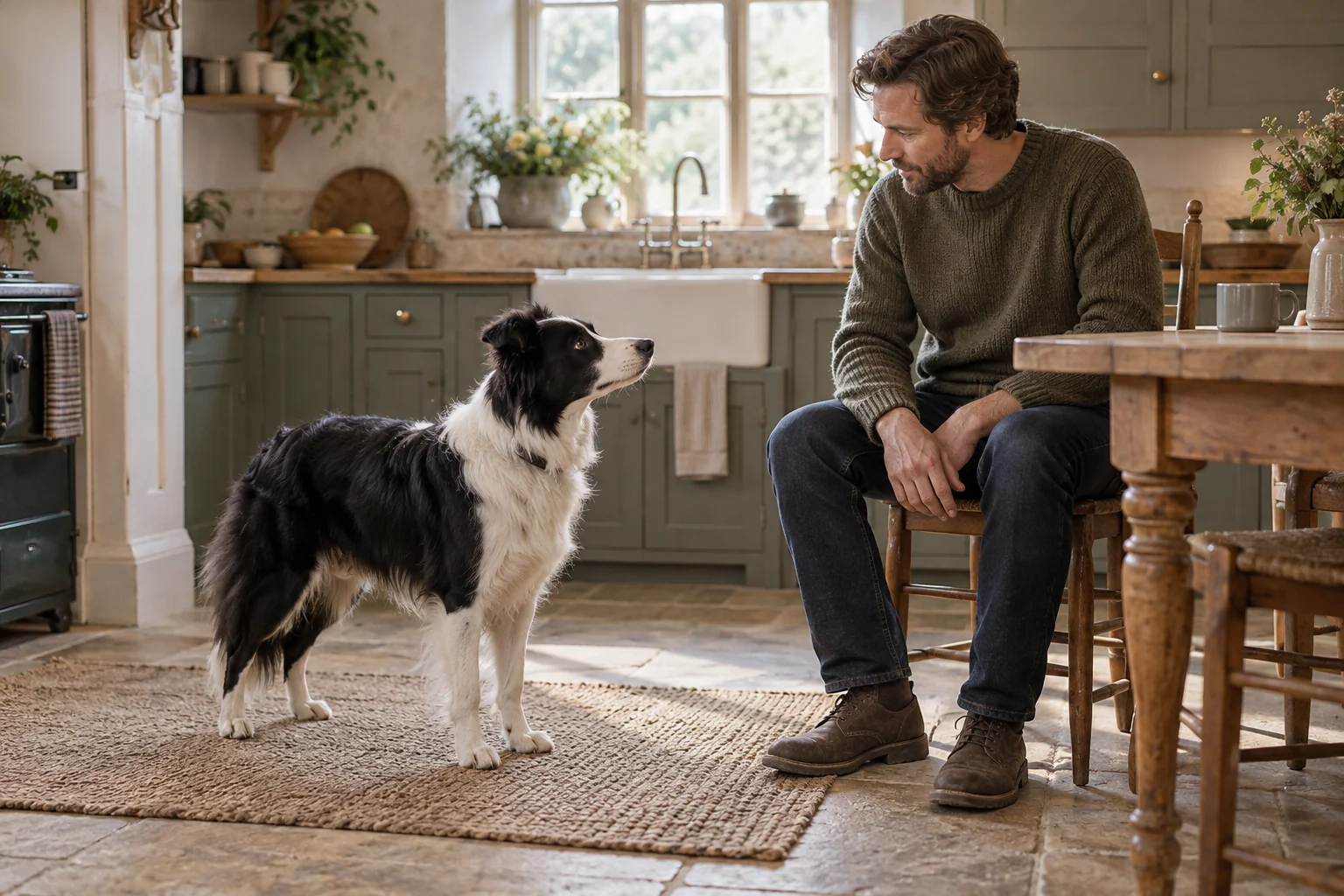
A border collie looking toward its owner in a quiet cottage kitchen

Your starting point / 02

Find your easy stretch.

The small goal
A few comfortable steps together on a loose leash.
Have ready
Well-fitting equipment and a quiet, safe place with room to move.

Separate the practice stretch from the rest of the walk. Start with one step and leave time for safe sniffing and ordinary dog life.

Start the walking exercise
A dog and handler walking together outdoors on a relaxed leash

Your starting point / 03

Make the next thing predictable.

The small goal
A clear household routine for toilet opportunities, activity and rest.
Have ready
An agreed potty spot, a comfortable resting place and a named person for the next outing.

Begin with the care routine. A short note helps the next person know what has happened and what your puppy may need next.

Build your puppy routine
A puppy in a grassy garden beside its owner

Your starting point / 04

Make a little room for quiet.

The small goal
A comfortable, voluntary beginning with a resting place.
Have ready
A non-slip mat in a quiet spot near you, at an undemanding time.

Notice an easy interaction with the mat and keep rewards quiet. Leave room for your dog to move away; begin without visitors or a busy household task.

Try the settling exercise
A dog relaxing on a mat in a peaceful room

No fixed pace. No need to do it all. Start with the version that feels comfortable for your dog.

Before the first repetition

Your dog training setup.
A little preparation.

You do not need a room full of equipment for dog training at home. Prepare the part of the day you can control: a comfortable place, an available reward and one small action to practise.

01 / THE PLACE

Choose a workable corner.

Look at the space before your dog joins you. Clear a route around furniture, cover a slippery patch and give other pets their own space. If the window is the interesting part of the room, begin somewhere quieter.

02 / THE REWARD

Have it ready to deliver.

Put suitable rewards within reach, with extras safely out of your dog’s reach. Decide where your hand will deliver the reward. Searching a bag after the response makes the sequence harder for you to repeat clearly.

03 / THE MOMENT

Check the ordinary needs.

A toilet break, water or rest may be more useful than a lesson. Choose a moment when your dog can comfortably join you. Practice can wait if the household is rushing out or your dog has just settled to sleep.

04 / THE PLAN

Write one visible action.

Try “turn towards me after their name” instead of “listen better.” Agree who gives the cue and what counts as the response. A smaller goal gives the whole household the same thing to notice.

01 / Teach your dog their name

Start with
“I’m listening.”

Attention is one of the positive reinforcement exercises you can practise in a quiet room. Before a longer walk or a new cue, reward one easy turn towards you. Have a few small rewards suitable for your dog ready.

A dog and owner sharing a relaxed training moment at home
The goal

Your dog turns towards you when you say their name. A brief glance is enough; a long stare is not the aim.

  1. Set the scene.

    Choose a room where your dog is already comfortable. Put away competing toys, prepare the rewards and begin nearby. Make sure their toilet, water and rest needs are met first.

  2. Say their name once.

    Use a friendly, ordinary voice. As your dog turns towards you, give a reward promptly. If you already use a marker such as “yes”, say it at the turn, then deliver the reward.

  3. Reset without rushing.

    Allow a pause before another repetition. After a few easy responses, finish. There is no need to keep going until attention runs out.

What to write down

“Turned towards me in the kitchen. Next time, start in the same place.” A useful observation beats a score.

02 / More comfortable walks

Loose leash walking.
A little more room.

Loose leash walking begins with a short, easy practice stretch. Separate it from the rest of the outing: your dog still needs time to sniff, explore and take care of ordinary dog business.

A dog walking beside its handler with a relaxed lead outdoors
The lesson is a few comfortable steps together, not perfect attention for an entire walk.
BEFORE YOU MOVE

Find the easy stretch.

Use comfortable, well-fitting equipment and a quiet, safe location. Begin with your dog near you and the lead loose. Reward that position before expecting several steps.

DURING THE PRACTICE

Make one step count.

Take a step. If your dog moves with you on a loose lead, reward near your side. Build up gradually. If the lead tightens, pause safely without jerking it; resume when there is slack.

WHEN IT GETS BUSY

Change the setting.

Repeated pulling is a reason to make practice easier. Move away from the distraction, shorten the exercise or return to a quieter place. End the training stretch with room to explore safely.

03 / Puppy training at home

Puppy training.
A gentle first week.
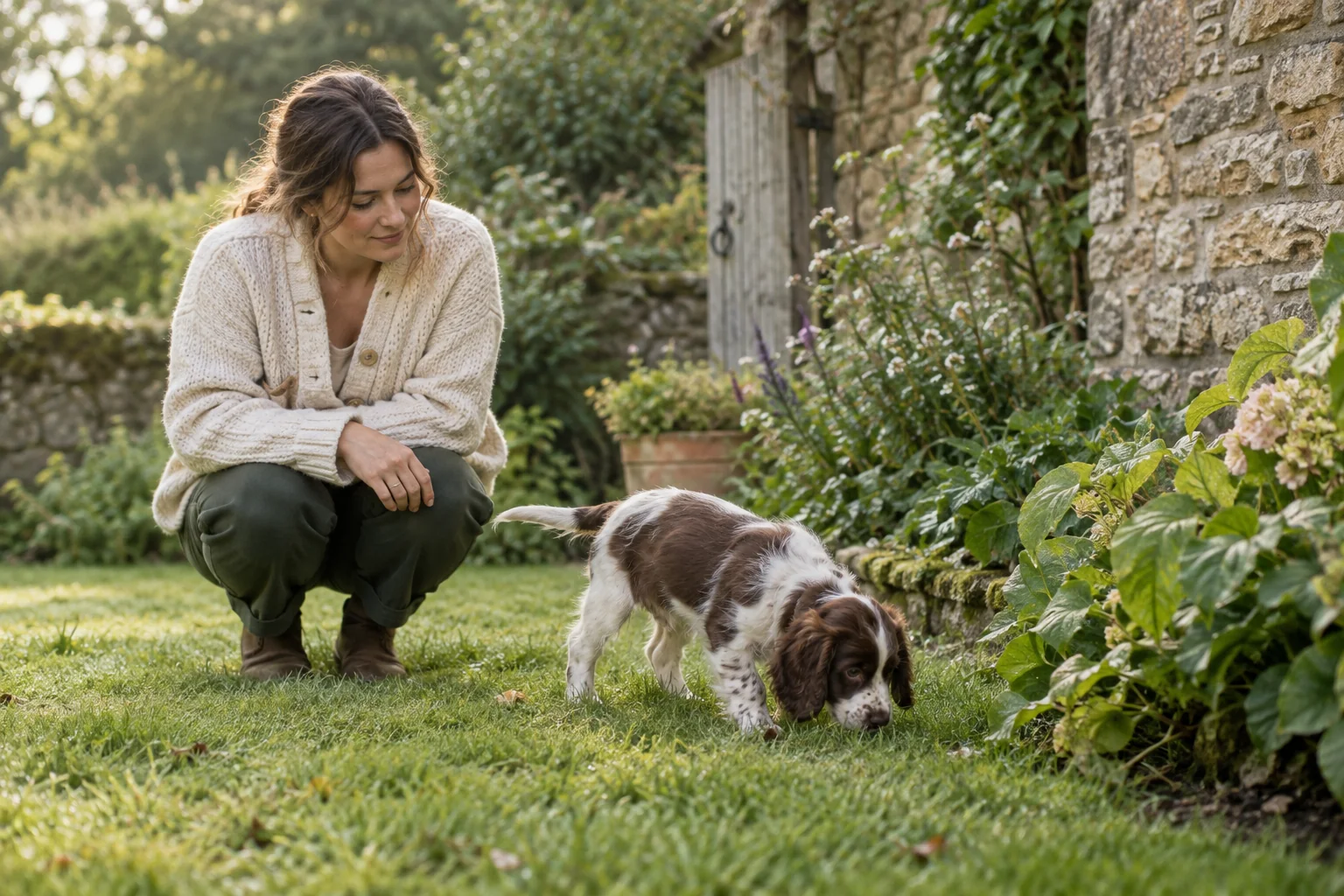
A puppy exploring a grassy garden beside its owner

Puppy training at home starts with a predictable care routine. In the first days, make the next ordinary thing easy to anticipate: a toilet opportunity, a little activity, then a comfortable place to rest.

Build a puppy potty routine.

Offer toilet opportunities after waking, meals and play, and whenever your puppy shows signs of needing to go. Go with them, then reward after they finish while you are still in the right place. If there is an accident, clean up calmly and adjust the routine; don’t punish it.

Keep a shared record.

A household note can be simple: “Woke, went outside, toileted, breakfast.” That tells the next person what has happened. Add the next likely outing instead of relying on everyone to remember the same conversation.

Choose one tiny lesson.

Practise an easy response to their name in a quiet moment. The rest of the day can be about settling into the household. You do not need to fill every awake minute with instructions.

For tonight

Agree who handles the next toilet outing, prepare the resting space and leave tomorrow’s rewards somewhere you can reach them.

04 / Mat training for dogs

Teach your dog
to settle on a mat.
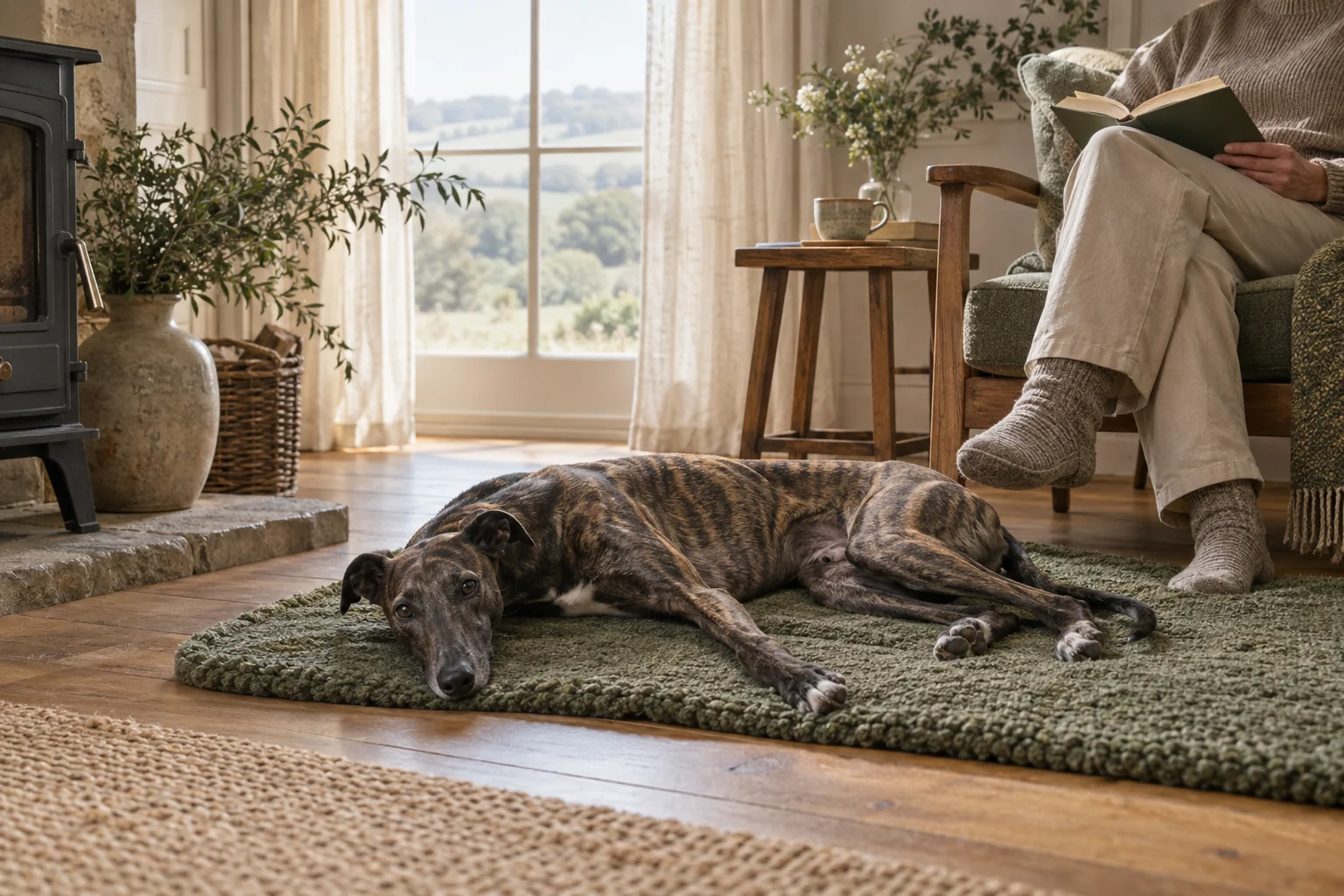
A dog resting comfortably on a mat in a quiet room

Mat training for dogs begins with a resting place they can choose to use. Put a comfortable mat or blanket near you, away from the household’s busiest route, and start at a quiet time.

Notice a small beginning.

Sit quietly nearby. Reward an easy choice such as standing calmly on the mat. Place the reward gently on the mat rather than turning the moment into an excited game.

Look beyond “lying down”.

Over time, notice relaxed posture or a head resting. Reward quietly. A dog who lies down but stays rigid and watchful may need a quieter setting, not a longer exercise.

Add time slowly.

Build duration in small steps over several sessions. If your dog gets up, let them; make the next attempt easier. Practise with small household movements only once the quiet version is comfortable.

For tonight

Try the mat while you sit with a book. Begin without visitors, cooking smells or a trip to a busy café.
05 / Dog recall training

Coming back.
Worth coming for.

Start dog recall training with a nearby return in a quiet room. The aim is to make arriving beside you rewarding before you ask for more distance or a busier setting.

A dog returning towards its owner during recall practice

Your starting setup

Where
A clear indoor space or securely enclosed garden.
Have ready
A reward your dog enjoys and one agreed recall word.
What to notice
Your dog comes all the way to you, rather than stopping several steps away.

The image illustrates the topic. Begin much closer than a long outdoor run.

  1. Begin with an easy invitation.

    Stand close to your dog, with no exciting activity to compete with. Get their attention, say your chosen word, such as “come,” and take a small step away. Keep your posture welcoming.

  2. Reward the arrival.

    Deliver the reward when your dog reaches you. Keep the first version simple; adding a sit or a long wait creates another task. Arriving beside you is the useful action here.

  3. Let the good moment continue.

    Often, release your dog back to a safe activity after rewarding. Coming to you should not always predict that every enjoyable thing is over. Leave a pause before inviting another return.

  4. Make the next attempt achievable.

    If your dog does not respond, avoid repeating the word over and over. Calmly reset closer or in a quieter place. Do not scold a late return. Keep outdoor freedom safely managed while the skill develops.

An example progression

Change the scene
one piece at a time.

These are practice ideas, not levels to complete on a timetable. Repeat the comfortable version whenever the next one is too difficult.

  1. The same room, a little farther.

    Imagine your dog returns easily from beside the sofa. Move only a small step farther away; keep the room, reward and cue familiar. Record whether the return still feels comfortable.

  2. A new room, nearby again.

    In the hallway, shorten the distance. A new surface, doorway or view can change the exercise. “Same cue, different room” is already a useful piece of practice.

  3. An enclosed outdoor space, an easy start.

    Check the enclosure first. Begin close, away from active distractions. An easy garden return does not establish that off-leash recall is safe beside roads, animals or open trails.

Positive reinforcement dog training

Clearer information.
Kinder expectations.

Positive reinforcement dog training rewards a behaviour to encourage it to happen again. Our positive reinforcement exercises put that into practice: choose one visible action, reward it promptly and simplify the setup when your dog needs help.

01 / DEFINE IT

Describe an action.

“Behave at the door” leaves a lot open to interpretation. “Keep four paws on the floor while I reach for the handle” describes a moment you can actually notice. It also makes the starting point easier to choose.

Try saying your goal aloud before the dog joins you. If it needs a whole paragraph, make it smaller.

02 / EXPLAIN IT

Make the reward timely.

Have the reward ready before the repetition. If you use a marker, follow it with the reward it promises. Practising your own hand movement first can be more useful than asking your dog for another attempt while you search a pocket.

Choose rewards your dog enjoys and that fit their dietary needs. Include food rewards in their daily intake.

03 / ADAPT IT

Change one thing.

A new room, more distance and a longer wait are three separate changes. Introduce one at a time. That way, if the exercise becomes difficult, you have a useful clue about what to simplify.

An easier repetition is a sensible next step. It does not undo what your dog has already learned.

Positive reinforcement in practice

Rewards that matter.
Timing that makes sense.

A reward is something your dog values in that moment. Choose it for the exercise you are teaching, then make the connection between the response and the reward easy to follow.

FOOD

Small and ready.

Use suitable pieces your dog can comfortably eat. Account for training food in their daily intake and respect dietary needs. Something enjoyed indoors may be less interesting in a distracting place.

For a nearby name response: prepare the reward before saying the name, then deliver it after the turn.

PLAY

A game they enjoy.

A brief game can reward a dog who enjoys toys. Plan how the game starts and finishes, including a comfortable way to release the toy. Exciting play may fit an active exercise better than quiet mat practice.

For a return in an enclosed space: have the game ready for when your dog arrives, with room to play safely.

EVERYDAY CHOICES

Room to enjoy life.

Where safe, access to something enjoyable can be part of the reward: continuing to a sniffing spot, for example. Watch what your own dog chooses; praise or touch is useful only when they welcome it.

For loose leash walking: notice a comfortable step, then allow a safe sniffing break instead of asking for constant attention.

A marker word or click

“That moment.
A reward is coming.”

A marker identifies the response you are rewarding. A short word such as “yes” or a click can do the job; choose a signal your dog can comfortably perceive.

Introduce the signal in a quiet setting: give the marker, then a reward. Repeat with pauses until your dog begins to anticipate the reward. You are teaching the meaning of the signal before using it to mark a new skill.

  1. 01

    Notice the response.

    Your dog turns towards you. That is the action you chose to teach.

  2. 02

    Mark that moment.

    Use the familiar marker as the response happens, rather than after another action.

  3. 03

    Deliver the reward.

    Follow the marker with its promised reward, then pause before another repetition.

A preparation exercise for you: without the dog, practise saying your marker, reaching to the reward pouch and delivering at the chosen height. Notice whether the pouch is easy to reach. Then put the food away until the actual session.

When real life joins the session

Something didn’t work.
What now?

Look at the specific moment before labelling your dog. These examples show how to turn a broad frustration into one practical adjustment.

Everyday examples, not diagnoses. Pain, panic, aggression or bite concerns need veterinary and qualified in-person support.

“They can do it at home, but not outside.”

Compare the two settings. In the kitchen, you may be nearby on a familiar floor. Outside, there may be smells, movement and noise before you even ask for the cue.

Try next: find a quieter outdoor spot, start close and ask for the smallest familiar version. Keep the distance and duration easy while the location changes. If your dog cannot engage comfortably, leave the exercise for another setting.

“We start well, then the session falls apart.”

Review what changed between the easy repetition and the difficult one. Did you add more steps? Did someone enter the room? Did you continue after your dog began turning away?

Try next: choose an earlier finishing point and prepare the reward before starting. Write down the last comfortable version. Next time, begin there instead of repeating the point where the session became frustrating.

“They only do it when I show the food.”

A visible food lure and a reward delivered after the behaviour have different jobs. If the food always appears before the action, it may have become part of the signal your dog is following.

Try next: in an easy, familiar exercise, separate the small guiding gesture from the reward held ready elsewhere. Reward the response promptly. If your dog is confused, return to the easier version and make the change more gradual; do not simply remove payment and expect the same result.

“Everyone in the house does it differently.”

Different words, hand movements and reward timing make it harder to understand what a session is asking. A shared plan can be shorter than a set of household rules.

Try next: agree one cue, one visible behaviour and one reward location. Put those three details beside the training equipment. Before adding a harder version, compare what each person is actually doing.

Read. Prepare. Try the easy version.

A small lesson,
right here.

Put dog training for beginners into practice with three original Dog Train Club exercises. Read the short sequence, prepare your space and use the full instructions beside each card.

Dog Train Club · Practice notes

An easy sit

  1. Prepare

    A quiet room. A comfortable floor. A reward ready.

  2. Notice

    Your dog’s bottom reaches the floor without pressure.

  3. Reward & release

    Reward promptly, then let your dog move again.

01 / An easy sit · Read the full steps before practising.

Notice the moment you reward.

Choose a comfortable movement, then make the reward timely. Read the sequence before starting so your hands are ready when the moment arrives.

  1. Begin on a comfortable, non-slip surface. Keep a small reward ready.
  2. If your dog comfortably follows a food lure, move it gently up and back from their nose. Reward when their bottom reaches the floor; never push them into position.
  3. Release after a short moment. Repeat only while the movement remains comfortable.

If your dog backs away, jumps or seems uncomfortable, pause. Reconsider the setup rather than lifting the lure higher or holding them in place.

Dog Train Club · Practice notes

A voluntary check-in

  1. Give space

    Start away from traffic and close greetings.

  2. Notice the glance

    Your dog chooses to turn towards you.

  3. Reward & carry on

    Deliver near your side. Leave room for a sniff.

02 / A voluntary check-in · Read the full steps before practising.

Let your dog choose connection.

A glance towards you is a useful moment to notice. Make that choice possible with space, a loose lead and a quiet setting.

  1. Begin with a comfortable lead setup, away from traffic and close greetings.
  2. Notice a voluntary glance towards you. Reward promptly, near your side.
  3. Continue with an easy step or a safe sniffing break. Your dog does not need to watch your face continuously.

A check-in is one moment, not a standard your whole walk must meet. Choose an appropriate place and make the next repetition easier if needed.

Dog Train Club · Practice notes

A short recall

  1. Start nearby

    Choose a quiet room or a securely enclosed space.

  2. Invite once

    Use a cheerful cue when a return is likely.

  3. Reward the arrival

    Reward close to you, then release to an ordinary activity.

03 / A short recall · Read the full steps before practising.

Make arriving the good part.

The end of the exercise matters: your dog reaches you and receives a reward. Begin close enough that returning is an easy choice.

  1. Practise indoors or in a safely enclosed space, with your dog already nearby.
  2. Use one cheerful recall cue when your dog is likely to respond. Reward arriving all the way to you.
  3. Release back to an ordinary activity. Build the easy version before adding distance or distractions.

This is a starting exercise, not proof that off-lead recall is reliable. Keep outdoor freedom safely managed while your dog is learning.

Puppies, adult dogs & older companions

The same kindness.
A different starting point.

Choose a lesson for the dog sharing your home today. Age, previous experience, comfort and the household routine help you decide what a manageable session looks like.

A puppy finding their feet

Make care the framework.

For puppy training at home, fit a tiny lesson around toilet opportunities and rest. You can practise a name response without turning an entire awake period into a class.

An example to try
After an ordinary care break, choose a quiet moment for a nearby name response. Reward the turn, then return to the rest of the routine.
A useful adjustment
If the household cannot prepare calmly, skip the lesson and organise the next care handover. Having a predictable day is useful work too.

An adult dog in your home

Start with what you observe.

A dog may know a cue elsewhere without finding it easy here. If you are new to each other, begin with a quiet, nearby exercise and learn what this dog finds rewarding.

An example to try
Describe a single moment you would like more of: a check-in before a walk or a relaxed pause beside your chair. Prepare that version first.
A useful adjustment
Keep your words and reward location consistent. Before adding a harder task, compare the comfortable response you have actually seen in this setting.

An older companion

Let comfort shape the lesson.

Older dogs may need changes to surfaces, movement or communication. Keep activities gentle and the surroundings accessible. Seek veterinary advice about new difficulty or changes in behaviour.

An example to try
Offer a brief, familiar attention exercise on a secure surface, without asking for repeated sit-to-stand movements or a quick run across the room.
A useful adjustment
Finish earlier if needed. Ask how to adapt cues if hearing or vision changes; a missed response is not a reason to become louder or more insistent.

A shared household plan.

Before tomorrow’s session, agree three details: the cue everyone will use, the response you will reward and the place you will practise. For example: “One person says the name in the quiet room; we reward a turn towards them.” Put the note where the next person will find it, then compare observations before increasing difficulty.

Your weekly dog training routine

Dog training at home.
A week to build on.

Use short dog training sessions to build a familiar routine. This is an example sequence, not a seven-day promise. Repeat a day, take a rest day or stay with an easier version for as long as your dog needs.

DAY 01

Choose the useful moment.

Pick one change that would make daily life easier. Describe it so you can see it happen: a turn towards you, a few loose-lead steps or a quiet moment on the mat.

What would “a little better” actually look like?

DAY 02

Find an easy starting place.

Use the same quiet spot for a few short repetitions. Prepare everything before you begin. Learn what the comfortable version looks like before you make it bigger.

Can we repeat this without adding a challenge?

DAYS 03–04

Build familiarity.

Return to the same exercise when your dog is ready. Keep a note of the setting and the response. One difficult attempt is information, not a reason to keep testing.

Which part of our setup is helping?

DAY 05

Change one small detail.

If the familiar version is comfortable, try a small adjustment: one extra step or a little more time. Keep the other parts easy. Return to the previous version if needed.

Did I change just one thing?

DAYS 06–07

Review, repeat, make room.

Look back at the notes and choose the next sensible starting point. Leave plenty of life outside practice: walks, suitable enrichment, companionship and undisturbed rest.

What should I make easier next week?

Make the next session easier

A little note.
A clearer tomorrow.

Keep the useful detail while you remember it. You can fill in this note, copy it and return to the same easy starting point next time.

An example to adapt
The setup
Quiet hallway, door closed, rewards ready.
What happened
A few comfortable steps. Opening the door changed the exercise.
Next time
Begin with the door closed and repeat the familiar stretch.

An observation helps you plan. It does not score your dog or diagnose a problem.

Your practice notebook

Leave tomorrow a starting point.

Fill in a short note, then copy it somewhere you keep your training plans. This website does not save or send your entries. Copy your note before leaving.

YOUR EVERYDAY COMPANION

DogPath training.
In your pocket.

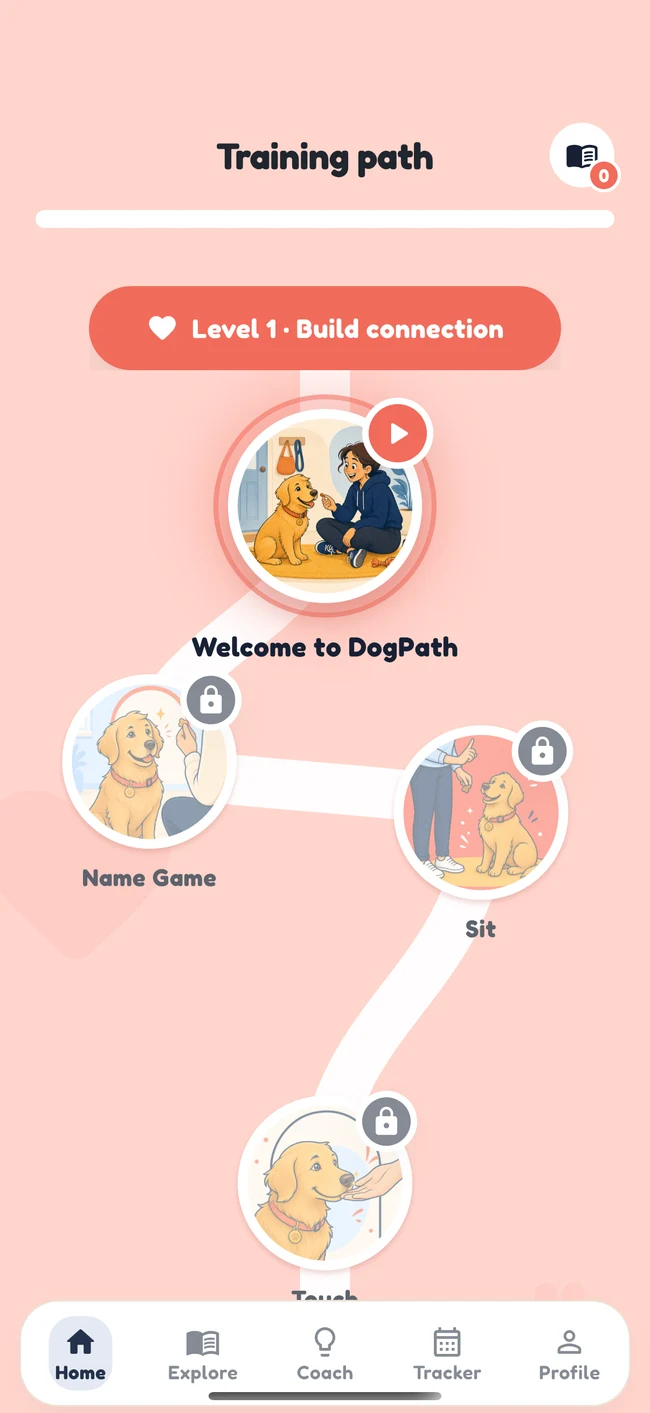
Meet DogPath, a dog training app for iOS and Android. Bring guided lessons, a training plan and your progress together so you know what to practice next.

Free to download
From the makers of Dog Train Club.

Take a look inside DogPath
ONE DOG. YOUR OWN PATH.
The real DogPath training roadmap, showing a sequence of guided lessons
A little practice, wherever life takes you.
01

A clear path

Know where to start and what comes next.

02

Useful little tools

Keep your clicker, timer and walk tracker close.

03

Your small wins

Record the moments you want to build on.

A few good questions

Before you
head out.

A little clarity for the next ordinary training moment.

What do I need for dog training at home?

Start with a quiet space, a reward your dog enjoys and one small goal you can observe. For the attention exercise, begin nearby and reward a turn towards you. For mat practice, add a comfortable, non-slip resting place. Prepare before you invite your dog to join you, and make sure their water, toilet and rest needs are met.

How long should dog training sessions be?

Keep short dog training sessions focused on a few easy repetitions rather than a fixed stopwatch target. Prepare first, practise one visible behaviour and stop while your dog is comfortable. If they repeatedly turn away, become worried or need a break, end sooner. Leave something familiar to return to next time.

How do I know when to make it harder?

Look for a comfortable, repeatable response in the current setup. Then change one detail, such as a little more distance, while keeping the others familiar. If the response falls apart, return to the previous version. Completing a day on a calendar does not mean the skill is ready for a busy new place.

Can an older dog start with these exercises?

Choose a starting point that fits their experience, movement and comfort. A familiar home exercise can still be useful for an adult dog. Adapt surfaces and positions where needed, and ask your veterinarian about new physical limitations or sudden behaviour changes.

Do I need the app to follow this page?

No. The exercises show you how to train your dog at home using the instructions on this page. The weekly example and practice notes are also free to use; an ordinary notebook can hold your observations. DogPath is an optional way to keep guided lessons, a training path and useful tools together. It is free to download; some features require payment.

When is a simple training exercise not enough?

Pain, sudden behaviour changes, severe distress, aggression or bite concerns need individual assessment. Give your dog space, avoid the difficult setup and contact your veterinarian and a qualified reward-based behaviour professional. Neither this page nor an app can assess the situation in person.

One useful moment is a good beginning

Make a little time.
Find your next win.

Prepare the space. Try an easy repetition. Leave room for tomorrow.