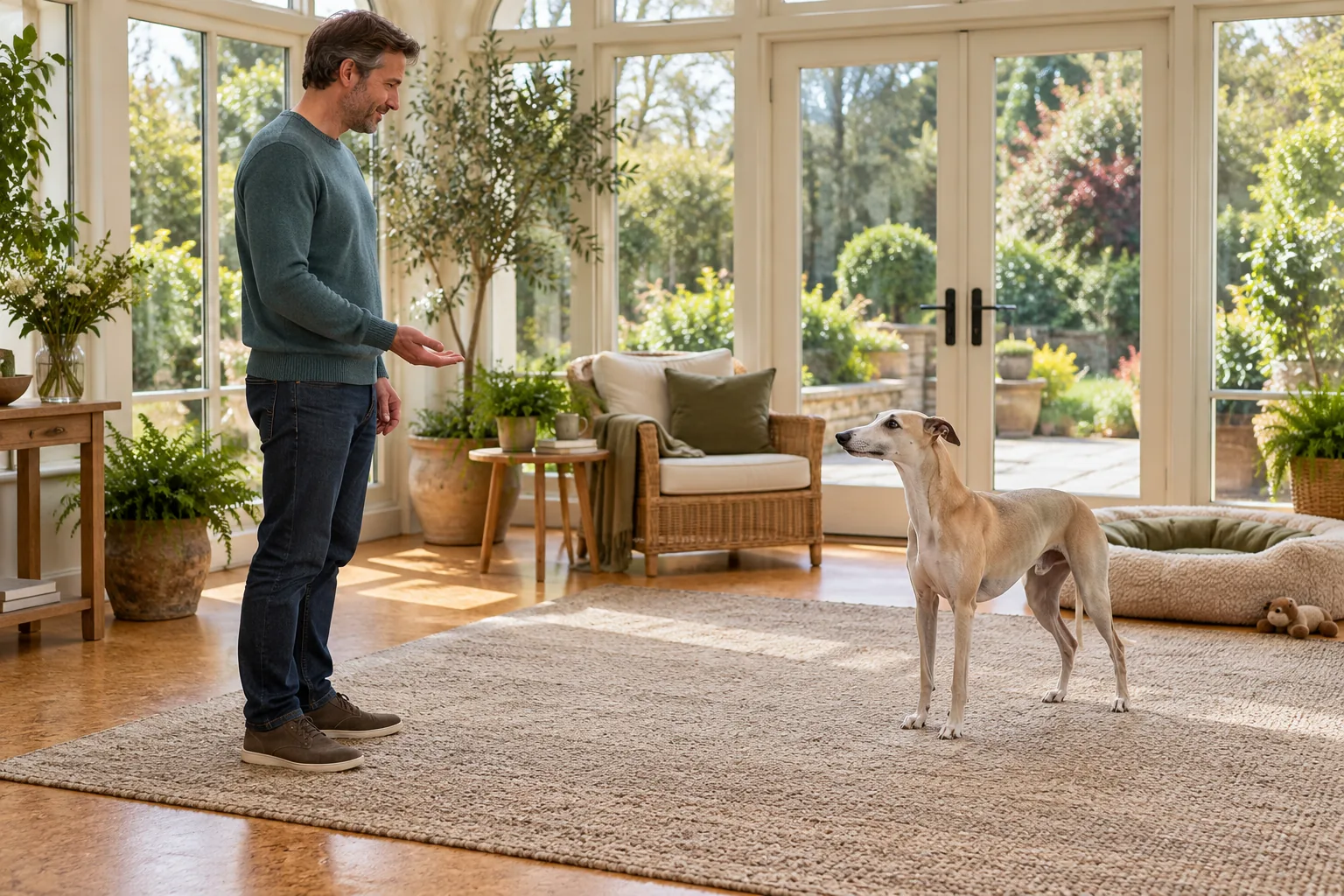
If your dog only responds to hand signals, the spoken word may not yet carry the information you think it does. You say a familiar cue with your hands still, receive no response, then move your hand and the dog understands. Treat that difference as something to teach. Repeating the word more sharply does not explain what it means.
Start with one comfortable behaviour in an easy, secure setting. This guide connects a new spoken cue to a known gesture, then uses DogPath to prepare appropriate foundation work and record what actually happened. It does not require replacing useful hand signals. Changes in hearing, pain, distress or safety need personal professional assessment; an article or app cannot establish the cause of a missed response.
Dog only responds to hand signals: notice the whole cue
Think about one recent ordinary example rather than arranging a surprise test. Perhaps your dog stood looking at you when you said the word, then followed the familiar hand movement. Describe the sequence on paper: your position, the word, the gesture and the response. Include whether the reward hand moved before anything else. Those details are more useful than a label such as stubborn or disobedient.
Your dog may also notice a bend at the waist, a step forward, the reward pouch or the direction you face. Changing all of those while asking for the same response changes the exercise. Keep the original comfortable position while you teach the word. You do not need to hide behind a door, turn your back or remove every visual detail to prove a point.
A sudden loss of response, changes in hearing or movement, possible pain, marked distress, growling or bite concerns need veterinary and qualified behaviour help. Stop optional training and manage the situation safely. Do not clap near the ears, startle the dog or force a position to investigate. A dog who uses visual communication can still have a useful, enjoyable training routine.
Choose one word and one comfortable response
Select an action the dog already performs willingly with a familiar gesture. A brief orientation towards you can be suitable if already taught. Choose a posture only when it is comfortable for that dog; sitting is not compulsory, and repeatedly sitting or lying down may be unsuitable for an individual. If the gesture itself is unreliable, return to the foundation before adding another signal.
Decide on a short word everyone involved can say consistently. Write down what counts as the response: for example, turning the head towards you, without requiring a long stare. Keep duration, distance and distractions at the familiar level. This first task concerns the cue that starts an action, not how long the dog maintains it or whether it works across a garden.
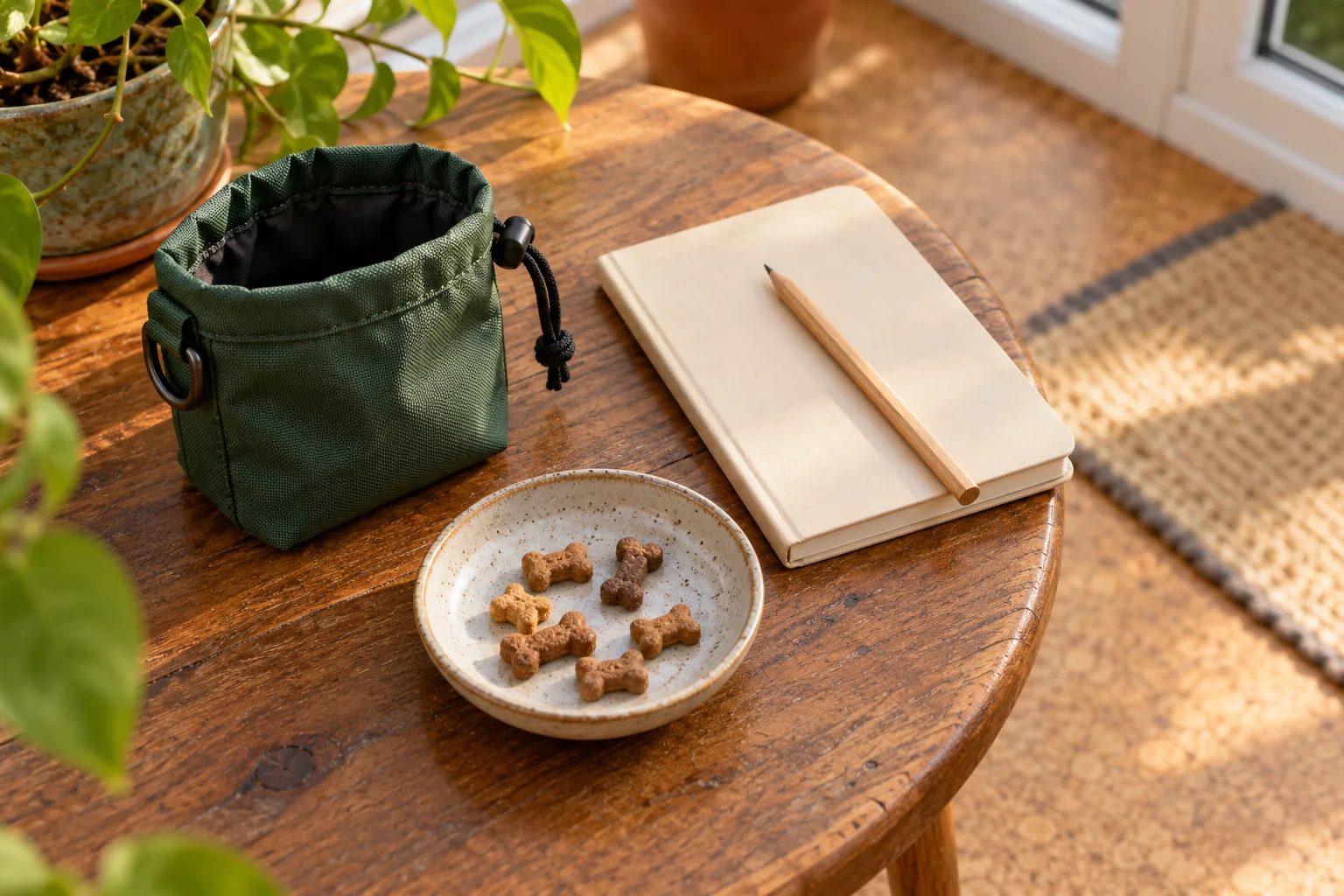
Have suitable small rewards ready before inviting practice. Keep hands neutral until you intend to give information, and avoid displaying food as part of every cue. Reward delivery still follows the response. Our reward marker guide explains that separate feedback skill if you need it; do not add an unfamiliar marker and an unfamiliar spoken cue in the same attempt.
Put the new word before the familiar gesture
In the easy starting arrangement, say the chosen word once in a normal voice. Let it finish, leave a small clear separation, then give the hand signal your dog already understands. Reward the comfortable response promptly. The useful sequence is word, familiar gesture, response, reward. If the dog responds after the word before you move your hand, reward that response without adding the gesture unnecessarily.
Avoid saying the word while your hand is already moving. That makes it harder for you to tell which part the dog used. Equally, do not stretch the pause into a prolonged examination. If the dog looks confused, moves away or stops participating comfortably, end the attempt. Later, review whether the original gesture and chosen behaviour were sufficiently familiar.
For example, a dog already turns towards a small open-hand gesture. The adult says the chosen word, then gives that same gesture and rewards the turn. Nothing else becomes harder. This is a teaching example, not a prescribed number of repetitions. Stop while the arrangement remains manageable; food, rest, water and necessary care never depend on completing the exercise.

Let the word earn meaning without taking help away
Across suitable opportunities, watch whether the response begins after the word and before the gesture. When that happens, reward it. You can then occasionally allow a brief opportunity for the word alone in the same easy setting. If help is needed, provide the familiar gesture without repeating the word several times. There is no benefit in leaving the dog waiting through an escalating series of demands.
The American Kennel Club discusses the influence of visual communication. That supports paying attention to your own movements; it does not show which cue your individual dog has learned. Keep your observations specific rather than assuming all dogs process words or gestures in the same way.
Do not remove rewards because a response now looks easy. Keep reinforcement clear while you introduce this new piece of information. A dog who responds when you gesture has demonstrated a useful skill, not failed a word test. You can retain both cues for different ordinary circumstances. If learning stalls, ask a qualified reward-based trainer to review timing and setup.

Use DogPath to prepare the relevant foundation
Read a suitable existing DogPath foundation lesson while the dog rests. Check what the lesson expects the dog to know, its preparation and the actual practice instructions. Choose it only if those prerequisites fit your selected response. An existing basic lesson can organise your practice; do not assume the app contains a dedicated hand-signal transfer course or a hearing assessment.
Prepare the safe space, rewards and equipment described in the lesson before the next opportunity. Write the particular word and gesture sequence separately on paper. If the lesson uses a different starting method, understand that difference rather than mixing two procedures halfway through an attempt. Where instructions or suitability are unclear, obtain personal help and leave optional practice for later.
Dog Train Club and DogPath share the publisher Rocket Digital Limited. This example uses the app's existing lesson preparation, training path, progress records and weekly planning. It does not claim automatic analysis of your gestures, speech recognition, diagnosis or a personalised cue-transfer program. The person still needs to observe the dog and decide whether an exercise belongs in today's routine.
Record the cue that actually helped
After practice, mark only the lesson work actually completed in DogPath. Opening instructions is different from completing the exercise. Follow the available completion options honestly, including leaving work unfinished when appropriate. A progress mark does not establish that the word works without a gesture, with another person or in a busy place.
Keep a separate paper note with the useful details: familiar room, adult standing sideways, word once, gesture afterwards, comfortable response. If the dog responded before the hand moved, note that observation without announcing that the cue is fully learned. If your hand moved early, record that too. The aim is to make your next decision clearer, not to create a perfect-looking record.
Use the weekly plan for one manageable reminder rather than adding daily tests. A later opportunity may repeat the same arrangement, simplify it or be skipped. Normal walks, exploration, care and rest remain part of the week. Our short training sessions guide helps with general organisation; this article's specific job is separating a word from a familiar visual cue.

Change one surrounding detail when appropriate
Once the word is becoming useful in the original arrangement, choose just one small change. Perhaps the same adult stands slightly more upright in the same room, while keeping distance and the response unchanged. Support the dog with the known gesture when needed. Moving outdoors, increasing distance and asking another person to speak all at once makes it difficult to understand a missed response.
The RSPCA recommends reward-based training. Keep that principle in place when the surroundings change: make the task achievable and reinforce the action you want. Loud repetition, physical positioning or withholding ordinary needs do not clarify the word. If you become impatient, finish and review your plan away from the dog.
Never use traffic, an open exit or proximity to another dog to test the new cue. A response in a quiet room cannot replace physical safety management. For separate work on coming when called, use our reliable recall guide with its preparation and management limits. This small indoor communication exercise is not proof of outdoor reliability.
Keep a shared household language
Tell other adults which word you are teaching, the familiar gesture and the small response you reward. Demonstrate without repeatedly calling the dog over for an audience. People can rehearse their own timing without the dog present, saying the word and only then moving the hand. That rehearsal often reveals how easily a person starts gesturing before finishing the word.
Keep useful visual communication available. A person may choose a gesture in a noisy room, while a word can be convenient when hands are occupied in a safe ordinary setting. Neither format is inherently a higher achievement. Accessibility, the dog's comfort and practical understanding matter more than a rule that every instruction must eventually become verbal.
Review a pattern across comfortable opportunities rather than judging a single missed response. If the change is sudden, the dog appears uncomfortable or your explanation no longer fits what you observe, stop and obtain professional advice. A clearer cue is a small shared learning task. Give it room to develop without making everyday care or the relationship depend on a performance.
Common questions
Should I stop using hand signals completely?
No. A familiar gesture remains useful communication. You can teach a spoken cue as an additional option while preserving visual support. Choose what is practical and accessible for the individual dog and situation.
Should the word or the gesture come first?
When adding a new word to an already familiar gesture, say the word first, finish it, then give the known gesture. Reward the response. If the response starts before the gesture, reward without adding unnecessary help.
Does this mean my dog cannot hear?
A missed spoken cue does not establish hearing ability. Sudden changes or concerns need veterinary assessment. Do not startle the dog or make loud noises near the ears as a home test.
Can the app confirm the word is learned?
No. A completion record documents work you actually did. Keep observations about the word, gesture and setting separately, and ask a qualified trainer for help when you need an individual review.