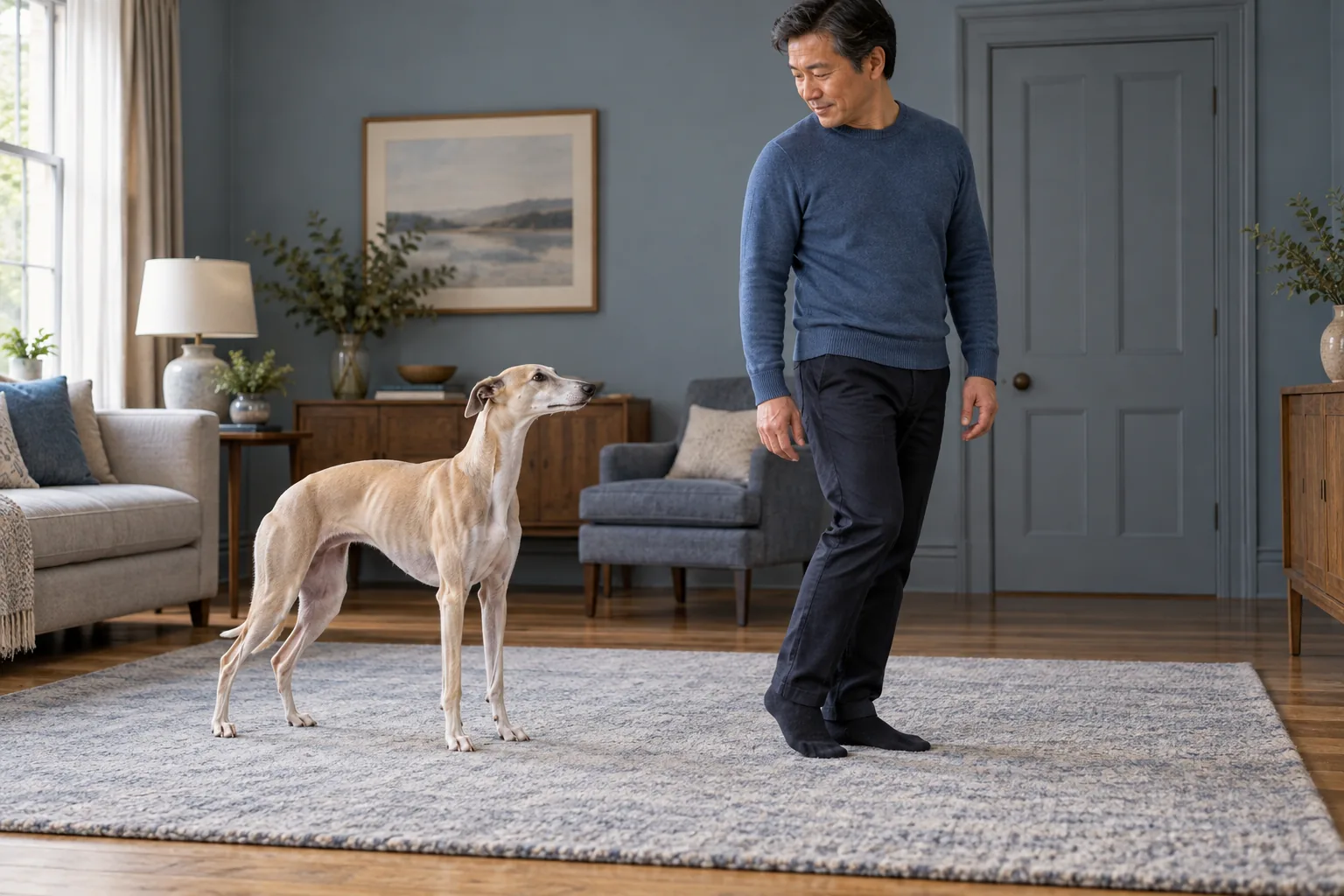
Your dog won't stay as soon as you move a foot. You return, ask again and take the same step; the dog follows again. Rather than turning that moment into an argument, make the change easier to understand. A nearby pause and a person's departure are different demands, even when the same word accompanies both. Start by separating your movement from the time the dog is expected to wait.
This guide focuses on a comfortable, supervised indoor exercise, with DogPath supporting preparation and review. It does not teach a dog to tolerate being left alone or to remain beside a hazard. Choose an appropriate existing lesson, put the phone away during practice and use a separate paper note for the movement you tried. A completed lesson records work; it cannot certify that a stay will hold in every situation.
Dog won't stay: describe the first change
Think of a recent ordinary attempt, rather than arranging a harder test. What happened immediately before the dog moved? Perhaps you turned your shoulders, lifted the reward hand, stepped backwards or looked towards the door. Note the starting distance and whether the dog had already been waiting while you found the treats. “Followed when my left foot moved” gives you something specific to simplify next time.
Check whether the easy version is genuinely available. Can the dog comfortably pause in the chosen position with you nearby and still? If that is uncertain, work on that foundation before adding departure. Do not add a longer wait to compensate for reducing distance. The point is to change one demand, not to make the same attempt feel different by increasing another. You can also stop and prepare a clearer opportunity later.
A sudden change in movement, possible pain, reluctance to sit or lie down, marked distress, growling or bite concerns need veterinary and qualified behaviour support. Do not press the dog's body into position or hold a collar to investigate. Distress when you leave the room needs individual assessment; staying still is not a treatment for separation-related difficulties. Skip optional practice whenever comfort or safe handling is unclear.
Prepare a comfortable place and a realistic finish
Use a familiar enclosed room, with external doors closed and a clear nonslip area. Move loose objects and food packets out of the path. Let the dog use a comfortable posture already understood; sitting and lying down are not compulsory for every dog. The photograph's standing example illustrates choice, not a requirement that your own dog adopt a different position. Water, rest and ordinary care remain available regardless of training.
Have suitable small rewards ready so you can deliver them without searching a pocket. Rehearse your own sequence without the dog: neutral hands, tiny movement, return to the original position, reward where the dog is. If bending or kneeling is difficult for you, choose an arrangement you can use comfortably or obtain personal help. Do not turn awkward human handling into a longer wait for the dog.
Agree how the attempt will end. If your dog already understands a release cue, use that familiar ending. Otherwise, establish an easy ending nearby before adding movement, inviting the dog to move after the chosen release word. Our reward marker guide covers a separate feedback signal. Make clear whether a familiar marker also ends the exercise; do not assume every household uses it in the same way.

Change a movement before asking for a full step
Imagine your original attempt involved stepping back across a floor tile. Your next plan might simply be a slight weight shift while both feet remain close to their starting points. Keep the dog nearby and the pause brief enough to be familiar. Return to your neutral position promptly, reward while the dog remains comfortably where they started, then use the agreed ending. You are exploring a manageable movement, not measuring endurance.
If the dog follows, let the movement happen without scolding, blocking or pushing them back. Pause, review the setup and choose something easier if another attempt is appropriate. Perhaps even the weight shift was too much, or the dog waited longer while you hesitated. Return to the nearby stationary foundation instead of repeating the same unsuccessful step. There is no requirement to obtain a final successful repetition before finishing.
The Dogs Trust stay guidance recommends returning to the dog to reward the maintained position. Apply that narrow principle to your own handling: reaching forward with food can make the dog step towards it. Prepare a comfortable delivery point instead. Keep breaks available, and leave turning away or increasing distance for another appropriate opportunity rather than adding them immediately.

Keep the reward and the release from giving mixed messages
Watch what your hands communicate. If the reward appears far in front of the dog's nose, stepping towards it is understandable. Bring yourself back into a suitable nearby position and deliver the reward without asking for a stretch. Avoid waving a treat to keep attention while your body moves away. That adds another moving target to an exercise whose main question is already about movement.
Separate a brief reward in place from an invitation to move, using signals whose meaning fits your established method. Do not start a recall at the end of every attempt and then wonder why the dog prepares to follow. At the same time, do not demand a motionless head, a fixed stare or a tense body. Decide what the actual exercise requires and what ordinary comfortable adjustments are irrelevant to that goal.
For example, a dog might stay at the chosen spot but turn their head towards a household sound. That is different from walking after you. If you suddenly make staring compulsory, the goal has changed. Describe the observation before changing the exercise. For a different goal, our mat settling guide explains a resting routine; a short taught stay and freely choosing to rest are not interchangeable.

Use DogPath before the dog joins the session
Open a suitable existing foundation lesson in DogPath while the dog is resting. Read the prerequisites, preparation and instructions from beginning to end. Compare them with what your dog can comfortably do now. If the lesson expects a starting position or feedback signal that is not yet familiar, choose an earlier appropriate foundation instead. Do not assume that a place in the training path means the individual dog is ready today.
Write today's specific question separately: “Can I shift weight slightly without adding a longer pause?” Keep that context note outside the app unless the current interface explicitly provides an appropriate place for it. Prepare the room and rewards, then put the phone somewhere safe. Scrolling while the dog waits can accidentally increase duration. The useful app workflow is reading ahead, practising with attention on the dog and returning afterwards to review.
Dog Train Club and DogPath share the publisher Rocket Digital Limited. This example uses existing lesson preparation, a training path, progress records and weekly planning. It does not claim a dedicated movement-analysis course, automatic stay scoring, a separation assessment or custom fields that have not been verified. If the chosen lesson and your proposed variation do not fit together, clarify the method with a qualified professional instead of combining instructions midway through practice.
Record actual work, then choose the next opportunity
After practice, return to DogPath and use the available completion options honestly. Reading a lesson is different from completing its exercise. Leave work unfinished if that is what happened, and do not mark several later lessons complete because one tiny movement looked comfortable. A progress record should represent practice, not a prediction of how the dog will respond in a new room or with a different person.
Keep a short separate note: quiet room, familiar standing pause, handler nearby, slight weight shift, reward delivered at the starting spot, release afterwards. If the dog followed, record the movement that preceded it and what you will simplify. If a visitor interrupted before practice, write that instead. These are useful decisions about circumstances, not a numerical rating of the dog's character or a diagnosis of why they moved.
Use the weekly plan for one manageable next opportunity. Repeating the same easy arrangement can be appropriate; the next entry does not have to add a full step. A busy day can remain a rest day without extra repetitions later to catch up. Our short-session guide helps organise general practice. Here the particular decision is whether movement, waiting time or the environment changed first.

Move only one part of the exercise forward
Once the small movement is comfortable in the original arrangement, choose a single modest change. That might be a slightly clearer weight shift with the same brief pause and nearby starting point. It need not be a full step, a turn and a longer wait together. Keep the previous easy version available. If you cannot describe what changed in a single sentence, simplify your plan before inviting the dog to practise.
Battersea's stay advice supports breaking difficult movements into smaller parts. Avoid converting that principle into a fixed schedule. Your room, your handling and the individual dog's comfort matter more than a distance target. Someone else's video of a long stay is not a reason to increase today's demand. Stop when the setting no longer fits the exercise.
Another adult or another room introduces a new context. Begin nearby with a familiar, easy version rather than testing the greatest distance you reached before. Share the cue, reward location and ending with the other person. Keep the dog supervised and free from physical restraint throughout. This article deliberately stops short of out-of-sight work; progressing an indoor skill does not automatically make leaving the dog appropriate.
Keep everyday safety independent of the cue
Do not test the stay at an open front door, beside a road, around hot cooking equipment or while another dog approaches. Close doors, use suitable physical safety arrangements and organise household movements before you need them. An exercise that looks comfortable indoors cannot replace a barrier. If a delivery arrives during practice, end the optional session and manage the entrance instead of asking the dog to prove reliability.
Review the practical result rather than announcing mastery. Did you notice that reaching for the tin took longer than the movement itself? Did your shoulder turn accompany the foot shift? Those observations can improve the next setup without making the dog wait longer. You may decide to rehearse your own movements alone, ask for personal help or return to the stationary foundation. None requires a difficult demonstration first.
Keep normal walks, exploration, comfortable rest and companionship in the day. A stay is a small communication skill, not a test of loyalty or a way to suppress every movement. Finish with ordinary care and let the next lesson reflect what actually happened. There is no promised number of sessions, no deadline for coping and no obligation to increase distance because the calendar has moved on.
Common questions
Should I repeat “stay” until my dog stops moving?
Do not turn the cue into continuous repetition. Pause and make the exercise easier. A nearby comfortable foundation and a clear ending are more useful than repeating the word more firmly.
Does a stay have to start in a sit?
Choose a comfortable posture your dog understands. Do not force repeated sitting or lying down. A change in comfort, movement or willingness needs veterinary advice rather than a harder training demand.
Should I call the dog to me for the reward?
For this exercise, return and reward at the maintained spot. Use a clear release separately. Calling the dog after every attempt can make following you part of the expected sequence.
Does finishing a DogPath lesson prove a reliable stay?
No. It records the work completed. Keep context notes separately and choose later practice from the dog’s actual response. App progress cannot replace supervision, physical safety or individual professional help.