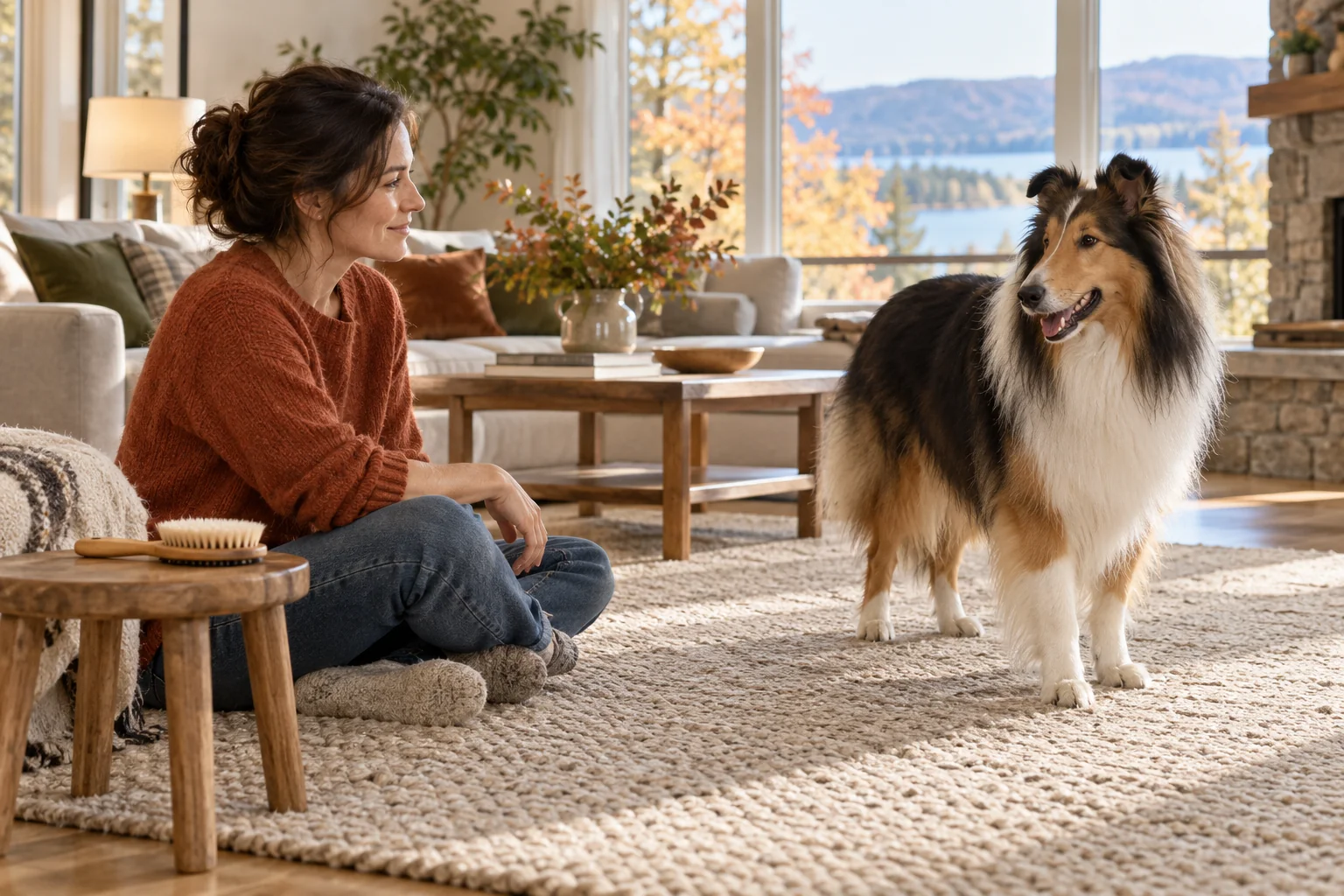
Is your dog afraid of the brush movements, or does the difficulty start as soon as you open the grooming drawer? Set aside the idea of finishing the whole coat for a moment. Seeing equipment, being approached, feeling contact and having a knot pulled are different experiences. An easier starting point depends on which part is uncomfortable, and on whether there is a physical problem needing attention.
This guide helps you prepare optional, gentle practice at home without holding a dog in place. It does not teach mat removal, medical treatment or handling a dog who may bite. Pain, skin changes, sudden avoidance, persistent distress or a risk of injury call for a veterinarian and suitable individual support. Essential coat care may need a professional plan while learning proceeds separately. A pleasant practice opportunity cannot replace necessary treatment.
Dog afraid of the brush: notice the first change
Recall the ordinary sequence before another session. Does your dog leave when you reach for the drawer, when the brush becomes visible, when you lean over, or only when it touches a particular area? Describe the first observable change rather than deciding the dog is stubborn. Turning away, moving out of reach, becoming still or repeatedly looking towards your hands can all be reasons to pause and reconsider the setup.
Do not repeat an uncomfortable action to obtain a more convincing demonstration. A short note such as “walked behind the chair when I lifted the brush” already identifies an earlier moment. If the dog welcomes ordinary company but avoids this particular routine, the starting task may be simply sharing a room with equipment at a comfortable distance. That observation does not diagnose fear, pain or the cause of the association.
Keep daily needs separate from practice. A dog with a tangled coat may need prompt professional attention, even if the first learning step is very small. Telephone the veterinary team or an appropriately qualified groomer and explain the handling difficulty before an appointment. Do not promise that a few rewards will make a necessary procedure possible at home. The care plan should fit both physical welfare and safe handling.
Check the coat and the plan before the tool
If ordinary touch has become unwelcome, arrange veterinary advice rather than trying several brushes in succession. Skin irritation, painful movement or a sudden change in behaviour deserves assessment. Look only as closely as your dog comfortably permits. Do not pull fur apart, poke a sore area or restrain the dog for an inspection suggested by an article. A professional can advise how to examine and care for the coat safely.
For routine maintenance, ask which tool and method suit your dog's coat. A soft-looking brush is not automatically suitable for every coat or enough to deal with tangles. The RSPCA's grooming guidance supports pleasant, brief brushing and stopping before discomfort; it also distinguishes introductory tools from effective coat maintenance. Get a demonstration on an appropriate, comfortable occasion instead of guessing at pressure or technique.
Keep scissors, clippers and knot-removal tools out of this practice. Do not cut close to the skin or drag a brush through a mat. If required care cannot wait comfortably, discuss that need directly with the veterinary team or groomer. Learning to feel safer around an ordinary brush is one part of a wider welfare plan, not permission to postpone painful or urgent problems indefinitely.

Make the floor space easy to leave
Use a familiar quiet room with secure footing and enough open space to move away. Floor-level practice avoids the extra challenge of an elevated grooming table. Clear clutter from the route and keep other animals and children elsewhere. Sit sideways without leaning over the dog. Keep the brush somewhere it will not fall or scrape unexpectedly, and put suitable small rewards within easy human reach before the dog joins you.
Our calm settling guide can help with the general arrangement of a restful space. Here, a rug supplies comfortable footing; it is not a command to stay. Do not block the dog between furniture and your knees or attach a lead to prevent departure. If you cannot maintain safety without restraint, stop the optional exercise and arrange personal guidance rather than improvising a holding method.
Plan the ending before you begin. You should be able to place the tool away and let the dog continue an ordinary activity without another person reaching in. Water, rest, companionship and access to normal household spaces do not depend on accepting grooming. A clear exit also makes your observation more useful: remaining near you means more when leaving was possible throughout the opportunity.

Let looking and touching remain separate tasks
Begin with a version your dog can already experience comfortably. That might mean the brush resting at a distance while you sit quietly, with no approach or contact at all. Notice a relaxed glance or ordinary comfortable presence and offer an appropriate reward in an easy place. Do not use the reward to draw the dog's face towards the bristles or bring the tool closer while the dog is occupied eating.
If the visible brush changes the dog's behaviour, put it away and make the next suitable opportunity easier with qualified advice if needed. A shorter distance is not a required next step. You can repeat the same comfortable arrangement, change where you sit, or postpone the exercise. No countdown determines when your dog must accept contact. The useful question is whether the whole setup remains comfortable, rather than whether a prescribed number of repetitions has been completed.
When movement of the brush is already comfortable, a tiny movement away from the dog can be considered separately from approach. Avoid swinging it towards the head or following the dog across the rug. Our reward marker guide explains feedback if that foundation is missing. Adding a new sound, new tool movement and first contact together makes the result harder to interpret; choose one small appropriate change.

Introduce contact only when it is appropriate
Only consider gentle contact if the dog is comfortable with the preceding preparation and with ordinary touch, and the coat-care method has been explained appropriately. Start on an area already comfortable to touch, following professional advice about the tool. A brief suitable touch can be enough for the entire occasion. Remove the brush, reward, and pause. Completion of the whole back or side is not the goal of this learning step.
Do not take food eating as proof that contact is welcome. Watch the whole dog and the option to leave. If posture changes, the head turns repeatedly towards your hand, or the dog shifts away, stop touching. Avoid following to finish a stroke. Stillness can also be a reason to pause, especially when the dog usually moves freely. You do not need to wait for growling before changing your plan.
The Best Friends guidance on grooming and handling supports gradual reward-based preparation and reducing stressful handling. Use that broad principle without turning this article into a restraint protocol. If you are unsure what a comfortable response looks like, ask a qualified professional to observe. A demonstration tailored to this dog is more useful than a household rule that every dog must tolerate the same sequence.
Stop while the decision is still straightforward
Choose a genuinely short opportunity that leaves you able to observe. Our short training sessions guide covers the general planning principle. For coat-care preparation, one easy moment followed by putting the brush away may be sufficient. Do not add an extra stroke because the first one seemed possible. Stopping early is a deliberate decision, not an unfinished challenge that needs correcting.
If the dog leaves, keep the route clear and end the practice without calling repeatedly or following with the brush. Ordinary friendly interaction can continue if welcomed. Avoid taking away normal comforts to make staying more valuable. You are gathering information about a particular care routine, not testing whether the dog chooses food over freedom. A departure tells you to review the preceding step and the environment.
Write down only what happened: tool location, human position, movement or contact attempted, and the dog's visible response. “Brush on stool; no contact; dog stood on rug, then walked to bed” is useful. “Accepted full grooming” would be inaccurate. Record interruptions too. A busy household may explain why an otherwise suitable plan was not attempted without making any claim about progress or the dog's feelings.

Coordinate necessary care with a professional
Tell the professional what your dog currently finds manageable, including whether ordinary touch, particular body areas or the sight of equipment cause concern. Ask about a suitable appointment setup, what preparation is helpful and what should be left alone beforehand. Share relevant veterinary advice rather than trying to manage a medical problem through training. Honest information helps a team plan safer care; concealing a bite history does not protect the dog.
Agree a practical maintenance plan between appointments. Ask what needs urgent attention, what can be managed comfortably and when to contact the team again. Avoid giving yourself a deadline such as finishing every leg by the weekend. Necessary care and optional learning have different purposes, and a professional may need to adapt how the former is delivered while the latter remains at an early stage.
For the next practice, retain the easiest useful detail and change only one thing if it is appropriate. A different adult is already a change; they should start from a comfortable arrangement instead of copying your furthest step. Share the stopping rule and keep hands and voices simple. Success here means a clearer, kinder decision about the next care opportunity, without claiming that fear has disappeared or that every future groom will be easy.
Common questions
Should I hold my dog still to finish brushing?
Do not restrain a worried dog for this optional practice. Stop and arrange suitable help if necessary care cannot be completed comfortably or safely. This guide does not provide a restraint or bite-management technique.
Can I use food while brushing?
Appropriate rewards can support gentle preparation. Do not use eating to distract from uncomfortable contact or lure the dog into reach. Watch posture and allow departure; taking food alone does not show that the dog is comfortable.
What if the coat has mats?
Ask a veterinarian or appropriately qualified groomer for a safe care plan. Do not pull through mats or cut close to skin. Small voluntary brush practice cannot substitute for addressing painful or urgent coat problems.
When should I seek veterinary advice?
Sudden avoidance, possible pain, skin changes or movement difficulty need veterinary attention. Persistent distress or concern about being bitten also calls for qualified individual handling support. Do not recreate the difficult event to prove the problem.