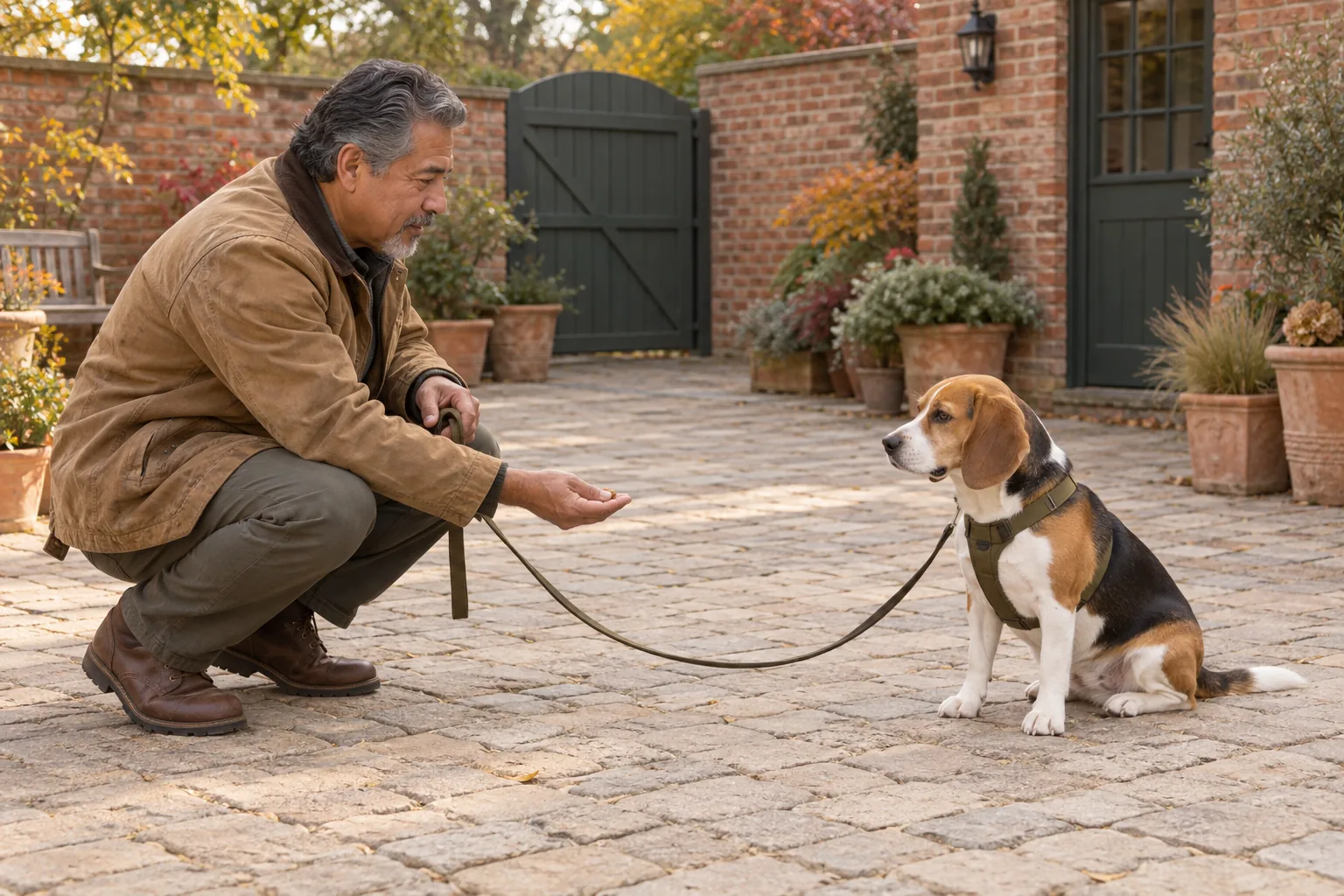
If your dog won't take treats outside but accepts the same food indoors, a planned exercise can lose its starting point. Repeatedly putting a stronger-smelling reward under the dog's nose tells you little about why this opportunity is difficult. Pause the exercise and look at the setting, delivery and the dog's ordinary wellbeing before asking for more.
DogPath can organise an actual suitable foundation lesson, preparation, honest completion and another manageable opportunity. It cannot diagnose appetite, calculate a safe exposure distance or declare a dog relaxed because food was eaten. Pain, sudden change, eating difficulties at home, marked distress or bite risk needs personal veterinary and qualified reward-based support. Keep normal meals, water and care available while deciding what practice fits.
Dog won't take treats outside: separate care from training
Start with the ordinary picture rather than a new test beside distractions. Is the dog eating their usual meals comfortably at home? Has anything changed suddenly? Are they moving normally and showing their familiar interest in daily life? Observations help you decide who to ask, but they do not identify a medical cause or rule one out.
If eating habits have changed, contact your veterinarian. The PDSA's reduced-appetite advice explains why changes deserve attention. Do not postpone appropriate care while shopping for training treats. Describe what changed and whether refusal also occurs at home; a progress screen cannot assess teeth, discomfort or illness.
When the difficulty is limited to an outdoor lesson, you can still stop that lesson without making a diagnosis. Go back to a comfortable ordinary routine. A dog does not have to take a reward to qualify for water, a toilet break, company or an appropriate walk. Do not skip meals to make food more persuasive.
Make the immediate goal modest: understand the conditions in which you offered the reward and prepare a manageable next decision. You are not proving that the dog is hungry enough or deciding whether reward-based training works. A useful pause can prevent an unsuitable exercise from becoming repeated pressure.
Describe the conditions without assigning a label
Write down one ordinary occasion. Where were you, how busy was the area and what happened just before offering the reward? “Outside the building while someone carried a trolley past” is specific enough to change. “Not food motivated” may conceal differences between places, timings and delivery. You do not need to provoke the incident again.
Include what the dog did: looked away, kept sniffing, backed up, froze or took food and spat it out. Those are observations, not a fear score. Refusal can accompany several different situations, and taking food alone does not establish comfort. Watch movement, posture and the ability to disengage from the scene as well.
Look at your own arrangement. A reward buried in a bag may arrive too late; a hand extended over the head may feel different from one offered low. An unfamiliar surface or a crowded doorway may make a tiny exercise harder. Keep other adults from offering competing instructions while you consider the setup.
Choose one practical detail to simplify rather than changing everything. Perhaps the same familiar food can be offered in a quiet secure courtyard instead of beside an entrance. If no ordinary outdoor setting seems comfortable, seek a personal plan. You do not need to locate a dramatic failure point to justify help.

Check familiar rewards before the outing
Choose small suitable rewards your dog already eats comfortably, respecting dietary needs and professional advice. Keep them fresh and carried in a clean container. A familiar texture or smaller piece may be easier to deliver than a large hard item. Avoid experimenting with several rich new foods to find something irresistible.
Check your handling in a comfortable familiar indoor situation, without withholding a meal or repeatedly testing appetite. Offer a small appropriate reward in an ordinary way and observe. If this is also difficult, revise the plan and consider veterinary advice rather than treating the doorway as the problem. The comparison is a practical observation, not a clinical test.
Prepare the pouch where you can reach it easily. Bring water and suitable equipment, and decide who holds the leash if another adult helps. Our reward-marker guide explains timing. Practise your own coordination before expecting the dog to follow a sequence in a more distracting place.
Do not push food toward a closed mouth, hold it there until the dog gives in or place it on unsafe ground. The reward needs to be suitable and wanted in that moment. More flavour is not a replacement for a manageable setting, and a particular product cannot guarantee participation outdoors.

Prepare the actual DogPath foundation while the dog rests
Open DogPath before the opportunity, with equipment put away and your dog comfortable. Read an actual available foundation lesson, its setup and prerequisites. The verified workflow includes guided lessons, a training path, progress records and a weekly plan. It does not establish a special food-refusal module or automated assessment of stress.
Choose a familiar easy foundation, such as voluntary attention or reward timing, where its instructions fit the dog's current abilities. Keep the goal narrow: prepare the place and see whether a small suitable step is manageable. Our short-session guide helps avoid turning a brief opportunity into repeated testing.
Put the phone away during practice. You need to notice the dog and surroundings without switching attention between a screen, leash and reward hand. Agree in advance what would end the attempt, including retreat, tension or difficulty moving naturally. A scheduled lesson is not permission to continue when the setup is unsuitable.
Dog Train Club and DogPath share a publisher, Rocket Digital Limited. The app helps organise your work; it cannot tell why food was refused or guarantee the next response. Leave the lesson unfinished if it does not fit. An honest record of preparation is more useful than completing an exercise the dog could not comfortably join.
Offer one easy opportunity in a manageable place
Choose a quiet familiar location with secure boundaries, clear ground and enough room to move away. Avoid beginning beside traffic, approaching dogs or a narrow busy exit. Check that the leash and harness fit comfortably and keep the leash slack where safe. The dog should not need to approach something worrying to reach your hand.
Wait for a brief voluntary look or another already easy foundation moment. Offer the small familiar reward at a comfortable position near the dog. Do not wave it ahead as a lure into a harder area. If accepted, observe the whole response: eating, movement and ability to turn away. Do not immediately increase the challenge.
If refused, lower your hand, pause and end the exercise if that is the suitable decision. Repeated offers can turn a simple observation into pressure. Resume ordinary care or move to a more comfortable arrangement with your safe management plan. Refusal is useful information even when you cannot identify its cause.
One easy moment is enough to review. Do not ask for a long stay or a series of cues just because a single piece was eaten. A quieter location can remain worthwhile for several occasions. You are seeking a usable starting condition, not measuring how close you can get to a distraction before food stops working.

Keep alternative rewards appropriate to the situation
Some dogs enjoy a familiar toy, quiet social contact or access to a suitable sniffing area. An alternative can support an exercise when it is genuinely wanted and safe, but it should not become a way to ignore marked distress or an appetite change. First decide whether training belongs in this setting at all.
A toy that causes frantic grabbing may be a poor choice near a busy walkway. Social touch is not automatically rewarding to every dog. A sniffing opportunity must be on a suitable supervised surface, without unknown food or hazards. Keep the activity small and observe whether the dog can participate comfortably.
Do not promise that replacing food with play solves outdoor refusal. You may instead need a quieter route, a shorter opportunity or professional help. The RSPCA recommends reward-based training and rewards suited to the dog. Apply that principle without insisting on one reward type everywhere.
If the adult struggles to manage equipment, space or the dog's response safely, pause practice and ask for individual support. Avoid leash corrections, intimidation and chasing. The useful adjustment may concern the environment rather than the reward. Ordinary wellbeing remains the priority even when the planned lesson cannot happen.
Record actual lesson work and keep context separately
Return to DogPath after the dog is resting. Mark only the actual lesson work you completed using the available progress controls. Reading instructions, preparing supplies and doing a single step are not automatically the same as completing the lesson. An unfinished task can accurately describe a sensible boundary.
Keep food-specific observations in an ordinary separate notebook unless an actual suitable field is available. Do not assume custom appetite logs, fear scores or automatic body-language analysis. Write the location, time, reward, delivery and visible response. “Quiet courtyard, familiar small piece, brief look, reward refused, session ended” avoids making an unsupported interpretation.
Add what you did not attempt. No new food, no closer approach and no repeated cue are useful limits for another adult to understand. If food was accepted, describe the narrow conditions instead of writing “outdoor training fixed.” Include the dog's return to ordinary activity and any concerns to discuss personally.
Use the weekly plan for another appropriate foundation opportunity, with room for normal care and changed conditions. A reminder does not create a deadline for accepting food outdoors. If the dog is unwell or the day is busy, postpone. Keep the record honest rather than adding unnecessary repetitions to maintain a streak.

Choose the next decision without escalating pressure
Compare similar occasions before changing your plan. A quiet morning courtyard and a crowded evening entrance are not equivalent settings. Preserve what seems manageable and change one controllable detail if appropriate. There is no need to combine a busier route, new reward and longer exercise on the same day.
Our comfortable walking foundations can support a few shared steps when already easy. They do not require every outing to become training. Keep appropriate exploration, toilet opportunities, water and rest without making them conditional on eating from your hand.
For sudden change, pain, appetite concerns at home, severe distress or bite risk, obtain personal veterinary and qualified reward-based advice. Share factual notes and ask how everyday outings should be managed while practice is paused. Never use repeated food offers as a substitute for that assessment.
The next useful outcome may be a prepared pouch, a quieter place or choosing not to practise today. Those decisions can make future opportunities clearer without promising a particular result. Keep app completion tied to actual work, and let the dog's ordinary wellbeing guide the size of the next step.
Common questions
Should I skip a meal so outdoor rewards work?
No. Keep ordinary meals and appropriate care. Making the dog hungry is not a substitute for a manageable setting or veterinary advice about appetite changes.
Does taking one treat prove the dog is relaxed?
No. Observe movement, posture and the ability to disengage too. Eating is one observation, not a diagnosis or clearance to increase difficulty.
Can DogPath tell why food was refused?
No. Use actual lesson preparation and honest completion; keep context in a separate notebook. The app cannot assess appetite, pain or a safe exposure distance.
What if the dog also eats poorly at home?
Contact your veterinarian for individual guidance, particularly with sudden change or other concerns. Pause training experiments while arranging appropriate care.