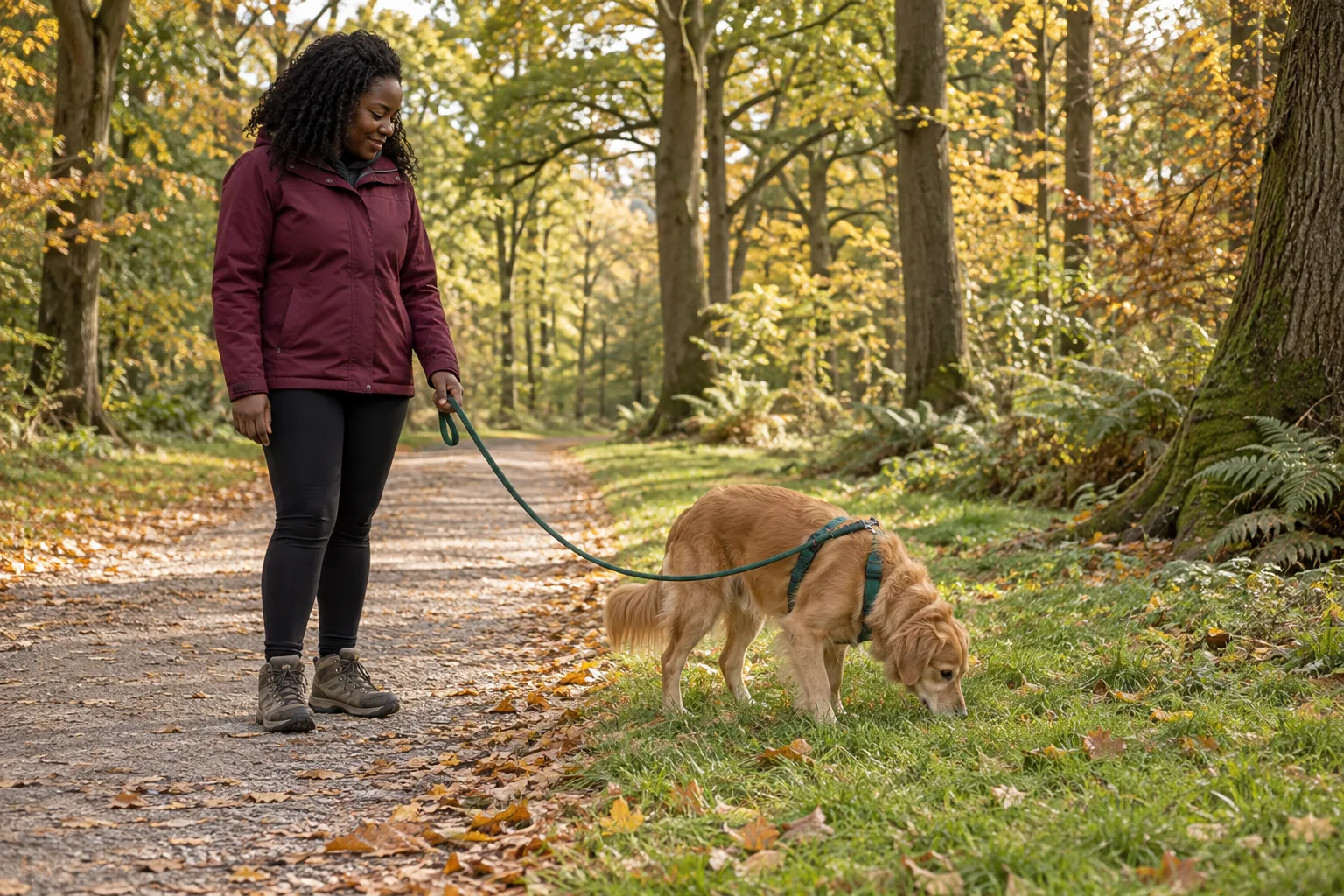
Dog sniffing on walks can make a familiar route feel much slower than you planned. That pause beside the verge is not automatically a training problem. Your dog is investigating, while you may be thinking about the distance left to cover. A workable outing can make room for both perspectives without allowing unsafe access or pulling the dog away from every interesting spot.
This independent guide helps you choose places to pause, notice the difference between exploration and difficulty, and invite a few shared steps when moving on is appropriate. You do not need an app, a scent game or a quota of completed metres. Adapt activity to your individual dog. Pain, sudden change, marked distress or bite risk needs personal veterinary and qualified reward-based help.
Dog sniffing on walks is part of the outing
A walk has more than one purpose. It can provide movement, toilet opportunities, company and time to investigate the surroundings. Sniffing a suitable patch and then looking up is compatible with a useful outing. You do not need to interrupt it simply because the dog's eyes are not on your face.
Dogs Trust's enrichment advice identifies sniffing as a natural way for dogs to gather information and encourages opportunities on walks. Keep that general idea modest: it does not promise that a particular number of sniffing minutes cures stress, replaces exercise or guarantees sleep. The practical question is whether this dog can explore safely in this place.
Think of the walk you can actually offer today. A short route with comfortable pauses may fit a busy afternoon better than rushing through a long circuit. It still needs to suit the dog's ordinary activity and care requirements. Seek individual veterinary advice about exercise where health, age or mobility makes the appropriate amount unclear.
Avoid making every sniff something to earn after perfect obedience. Equally, exploration does not mean unlimited access to any verge or object. You remain responsible for the surroundings. A realistic plan gives the dog useful choices within safe boundaries, rather than demanding constant attention or abandoning supervision.
Choose a route with places where you can pause
Before setting out, imagine where you can comfortably stand while leaving a clear passage for other people. A broad quiet path with visible low vegetation is easier to supervise than a narrow pavement edged by traffic. A familiar loop can offer several appropriate stopping places without requiring a special expedition or a completely new environment.
Look at the actual ground when you arrive. Litter, sharp debris, unknown plants, mushrooms, chemicals or hidden objects can make a previously useful spot unsuitable. Appearance cannot establish the safety of an unknown item. Choose another area when visibility is poor, and avoid planting food outdoors to encourage investigation. Sniffing does not require eating from the ground.
Give wildlife, livestock, other dogs and people generous space. Do not let the dog investigate somebody else's bag, garden or resting animal. Respect local access and leash requirements without assuming a rule from another country applies here. A longer route is unnecessary if getting there creates more difficulty than the exploration itself.
When time is limited, choose a shorter route with room for toilet needs and a comfortable return. Arrange another exploration opportunity if an errand requires a hurried journey.

Hold the leash so exploration remains comfortable
Use equipment that fits comfortably and is suitable for this dog and location. Check the harness, attachment and leash before leaving. A fixed leash with enough room for a nearby sniff can be useful on a quiet path, provided you can supervise the space. More length is not automatically better in a crowded area or around obstacles.
Keep the leash clear of paws, your legs and other people. Do not wrap it around fingers or tie it to a bench while you stop watching. Stay close enough to manage the surroundings without stretching a tight line between you and the dog. Move your own feet when that safely gives room; avoid pulling the neck or steering by repeated jerks.
Our loose-leash foundation guide covers a separate skill for comfortable shared steps. Use those foundations to support the transitions, while leaving the sniffing pause as genuine exploration. This article does not require a heel position or promise that adding pauses will resolve persistent pulling.
If you cannot safely manage the dog or equipment, ask for personal reward-based help before attempting a more spacious arrangement. A lead provides a physical boundary; it is not a reason to allow access beside traffic, an exposed edge or an animal that may react. Comfortable exploration begins with a place the adult can supervise.
Let one safe pause unfold without a performance
At a suitable visible patch, stop where you are stable and the leash stays loose. Let the dog choose whether to investigate it. You do not need to point repeatedly, push their nose toward a scent or scatter rewards to make the pause look successful. Some dogs will look briefly and move on; others will spend longer on that particular spot.
Watch the surroundings as well as the dog. Keep passing routes open and be ready to choose another location if the area becomes busy. A pause near a clear verge does not have to continue when a cyclist approaches or another dog needs space. Plan changes before the situation becomes difficult, rather than waiting for a confrontation.
Notice what is actually happening: sniffing the surface, lifting the head, moving along the edge or choosing to return beside you. Those details help you understand preferences without claiming to read every scent or diagnose emotional state. A dog repeatedly searching frantically, unable to move comfortably or showing distress needs a different arrangement and possibly professional advice.
There is no universal stopwatch target. Stay long enough for a manageable opportunity, with attention to weather, physical comfort and the rest of the day. Your useful outcome is an appropriate pause and a safe next decision. It need not be a dramatic change in behaviour or a photograph proving that the dog was entertained.
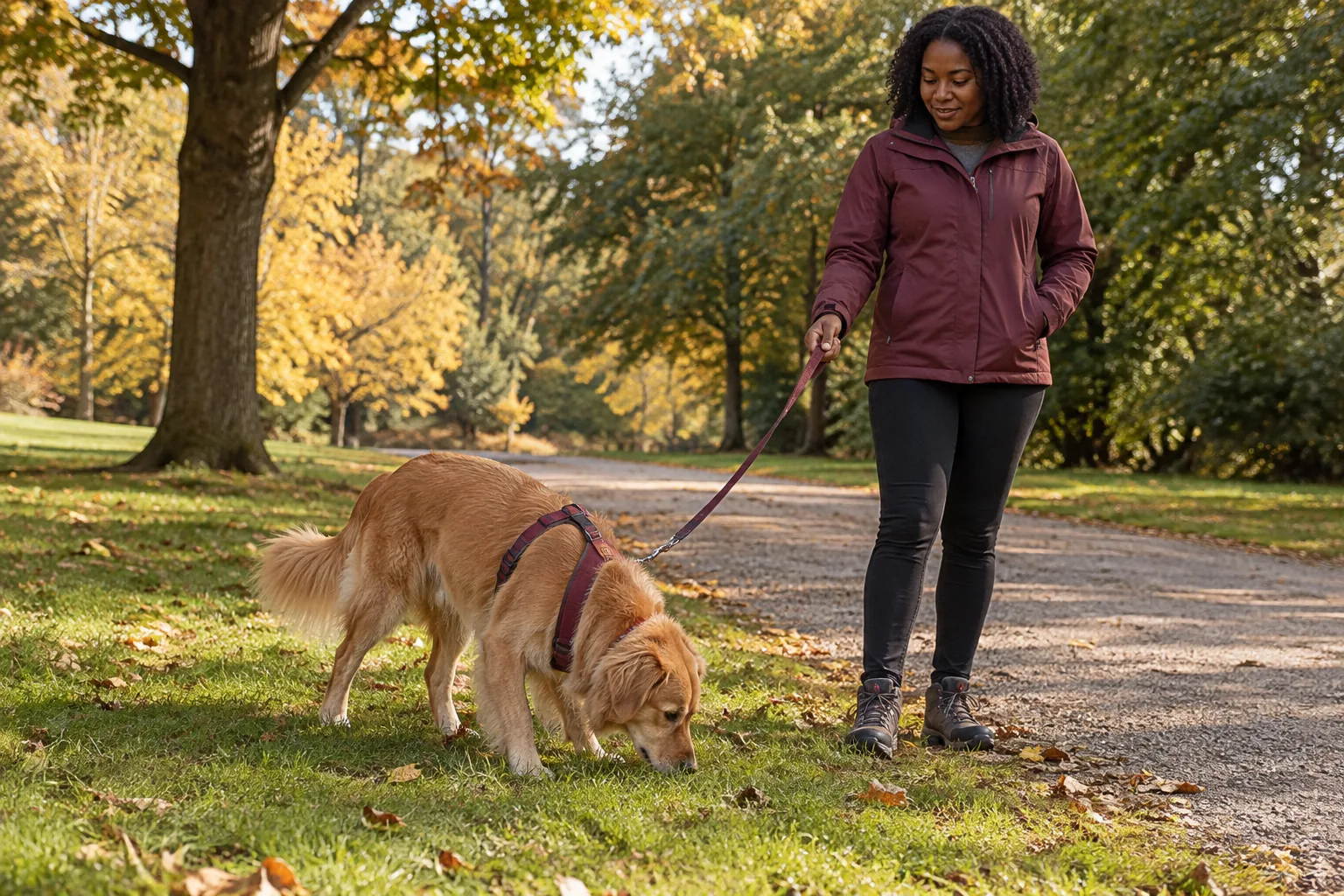
Invite a few shared steps before the next pause
Practise moving on first in an easy familiar place when no urgent departure is needed. Wait for the dog to lift their head or offer brief voluntary attention. Use a gentle familiar invitation and take one or two comfortable steps. Reward joining you in an appropriate position, without repeatedly waving food ahead of the dog's nose.
Our reward-marker guide explains identifying a useful moment. If the dog already understands a marker, use it naturally and deliver a suitable reward from your hand. Keep coordination simple. Then offer another appropriate pause so every turn toward you does not necessarily end the whole outing.
If the dog cannot disengage, reduce the difficulty instead of repeating the invitation louder. Try the shared-step practice in a quieter area, separate from a particularly absorbing scent. You can wait briefly when safe, or choose a simpler route next time. Do not jerk the leash, drag the dog or withhold ordinary meals to increase interest in rewards.
An immediate hazard requires a safe management response, not a recall experiment. Use the personal safety arrangement you can reliably manage, keep adequate distance and get help if transitions regularly become unsafe. The small exercise here builds a useful ordinary invitation; it cannot guarantee a response beside unknown food, wildlife or traffic.

Distinguish sniffing from picking things up
A nose near the ground does not automatically mean something is being swallowed. However, sniffing permission is not permission to collect every object. Maintain a clear view and choose surfaces you can supervise. If a spot contains leftovers, sharp litter or an unidentified item, move to an appropriate alternative rather than using it as a test of training.
Do not reach into the dog's mouth, chase them or pull an object away when that creates bite risk. If they may have swallowed something harmful, contact a veterinarian promptly for individual guidance. Do not wait for an app record or a later training session to establish whether the object was safe. Training and urgent care have different jobs.
For repeated scavenging or difficult exchanges, plan safer routes and obtain qualified reward-based support. Preserve normal meals and offer supervised exploration where suitable.
Avoid giving scent exploration medical labels or claiming it treats a compulsive pattern. An abrupt change, repeated distress, unusual reluctance to move or possible pain deserves veterinary discussion. Share factual observations about the setting and movement without repeatedly recreating a difficult event for evidence. A thoughtful walk makes space for investigation while preserving those boundaries.
Keep busy days workable with a shorter plan
Imagine a day when you have less time than usual. Choose a nearby quiet loop, allow an appropriate pause on the first clear verge, walk a comfortable short section and return through the same manageable area. This is an example of route planning, not a fixed prescription for how much exercise your dog needs.
On another day, the usual verge may be busy with maintenance or blocked by parked equipment. Change the location rather than demanding the same performance under different conditions. A suitable clear patch nearer home may be enough for exploration while you reorganise ordinary activity. Do not take the dog somewhere overwhelming simply to provide novelty.
If you include a separate training moment, our short-session guide helps keep it limited. One voluntary turn and a few easy steps can be sufficient. The rest of the outing does not have to become a sequence of tests, and you need not rehearse cues throughout every sniffing pause.
Protect water, rest and physical comfort. Bring appropriate supplies for the conditions and postpone unnecessary exposure to difficult weather. Stop and seek personal advice if the dog seems unwell or the amount of activity is unclear. Giving choices means adapting to the dog in front of you, not filling a daily distance target regardless of their response.
Review the route rather than scoring the dog
After the dog is comfortable at home, make a small note if it will improve the next outing. Write where you paused, what made the location manageable and how moving on worked. “Wide verge, clear surface, brief look toward me, two steps then another pause” is more informative than “finally listened.” You can use ordinary paper; no app or special tracker is needed.
Compare similar conditions: a crowded path and quiet loop are different situations. Preserve what helps and simplify a controllable detail when a transition is difficult.
The RSPCA's sniffari guidance encourages time to investigate through scent while avoiding unsafe situations. Apply that principle within your own practical route and individual care plan. Avoid universal claims about replacing physical activity, guaranteeing calmness or providing a specific health effect.
Agree the plan with other adults who walk the dog. Explain which places are suitable and what invitation is familiar, with space for conditions to change. The useful next outing may cover less ground but include a safer pause and an easier transition. Keep exploration, movement and ordinary wellbeing together without demanding a perfect walk.

Common questions
Should I stop every sniff to keep my dog attentive?
No. Supervised investigation in suitable places can be part of the walk. Constant eye contact is unnecessary; practise voluntary transitions separately in easy conditions.
Can sniffing replace all physical exercise?
Do not assume that. Movement, care and exploration needs vary with the individual dog. Ask your vet about appropriate activity when health or mobility is a concern.
What if my dog will not move on?
Simplify the setting and practise a few shared steps where disengaging is easier. Avoid leash jerks or dragging; get personal help when management is unsafe.
Is it safe to sniff anything outdoors?
No. Supervise visible suitable areas and avoid unidentified objects or hazards. Possible harmful ingestion requires veterinary guidance rather than a training test.