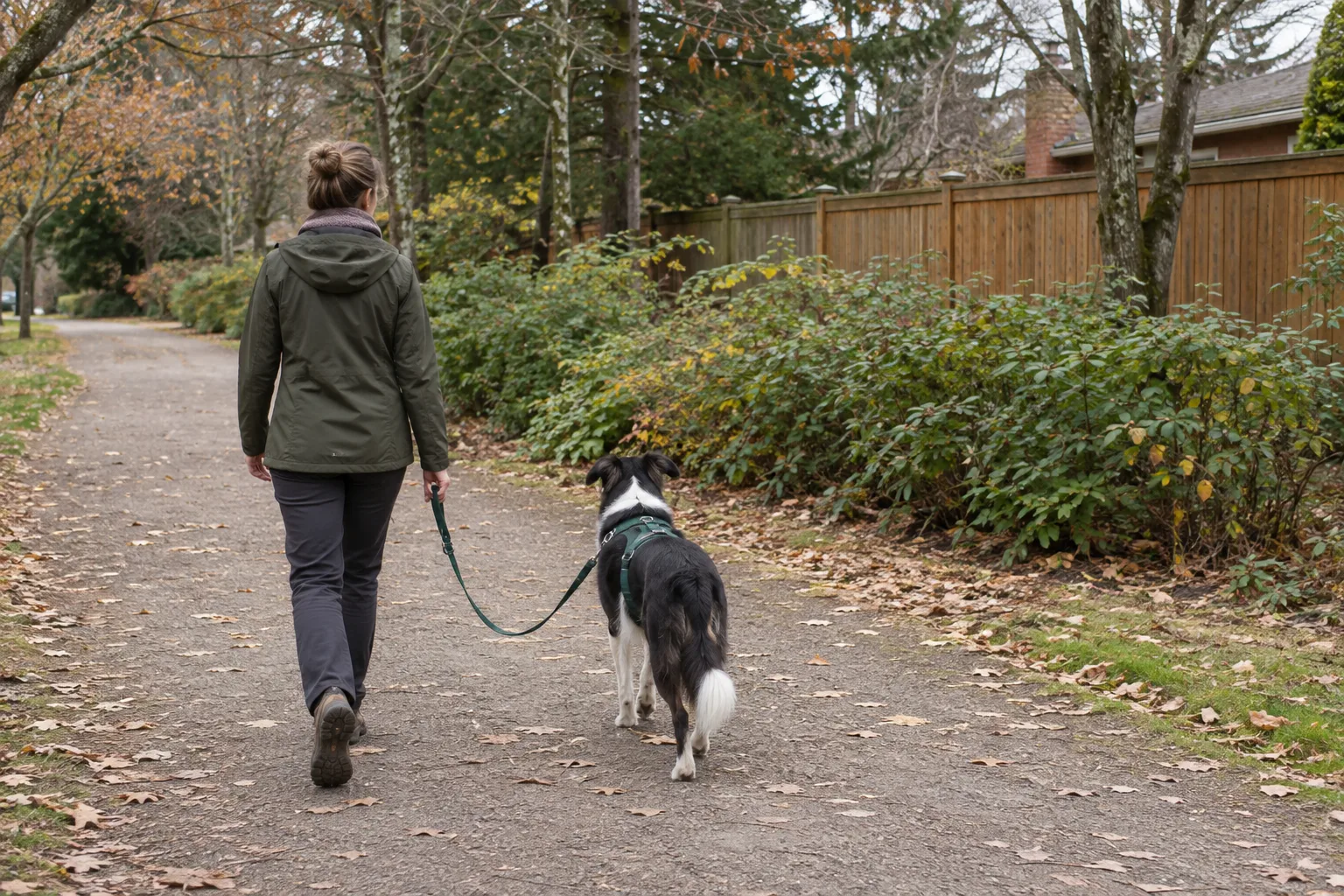
If your dog is scared of barking dogs behind fences, the ordinary walk can change at a single address. Your dog may stop well before the gate, refuse to come around the corner or turn to head home when barking starts out of sight. The useful decision is often the one you make before you get close enough to see the other dog. Leave the stretch of pavement if you need to and keep the rest of the walk predictable.
This guide is for the dog on your side of the fence. You can choose a route, practise a quiet turn and keep track of changes you see without arranging an encounter. DogPath can help organise an existing foundation exercise away from that location. The neighbour's dog, the timing of the barking and the width of the footpath are outside the app's control. You can use another route for as long as you need.
Scared of barking dogs? Start farther back
Decide where you will change direction before you reach the gate. A side path or a wide bend that gives you a comfortable exit is more useful than the last narrow piece of pavement. Look for one while you are walking without your dog, or use a familiar route you already know. Keep your dog on a secure fixed-length lead. Leave enough room to turn and keep the lead from trailing or going tight as you move away.
Watch for the first change from your dog's usual walk. Their stride may shorten, their head may swing toward the fence or they may stop sniffing and hold still. You can change direction as soon as you see that first change. If a bark surprises you before then, pause just long enough to pick a safe exit and move away together when your dog can follow. A dog who needs a little time to start moving again deserves space and patience.
Plan two walks from the same doorstep
Keep one route that avoids the address entirely. It may be shorter, but it can still give your dog a chance to sniff and move at a comfortable pace. Choose a second route only if there is a useful option with generous space and a way back. On a day when your dog has already had several difficult encounters, use the route that asks less of them. You can do this even if the other dog is often quiet in the morning.
Look at the approach from both directions. A solid fence can hide a barking dog, and the corner that leaves plenty of room in one direction may be tight in the other. A parked car can block the wide part of a pavement that you used yesterday. Mark the last point where you can turn without stepping into traffic or passing close to anyone. If the other side of the street is a good alternative, use a safe crossing well away from the gate. Crossing in a rush while handling a startled dog adds a new difficulty.
The Humane Society of the Pikes Peak Region's guide to barrier reactivity discusses planning for predictable fenced areas and increasing distance. Here the route is the safety measure, even on days when you practise no cue at all. If there is no spacious walking option on this block, choose another destination instead of trying to get past the fence with food or a tight lead.
Agree on the route with anyone who walks your dog. For example, point out the bench where you turn before the next garden. Tell them which alternative goes back toward home if the first path is blocked. A simple shared decision helps when someone else is holding the lead and hears a bark they weren't expecting.
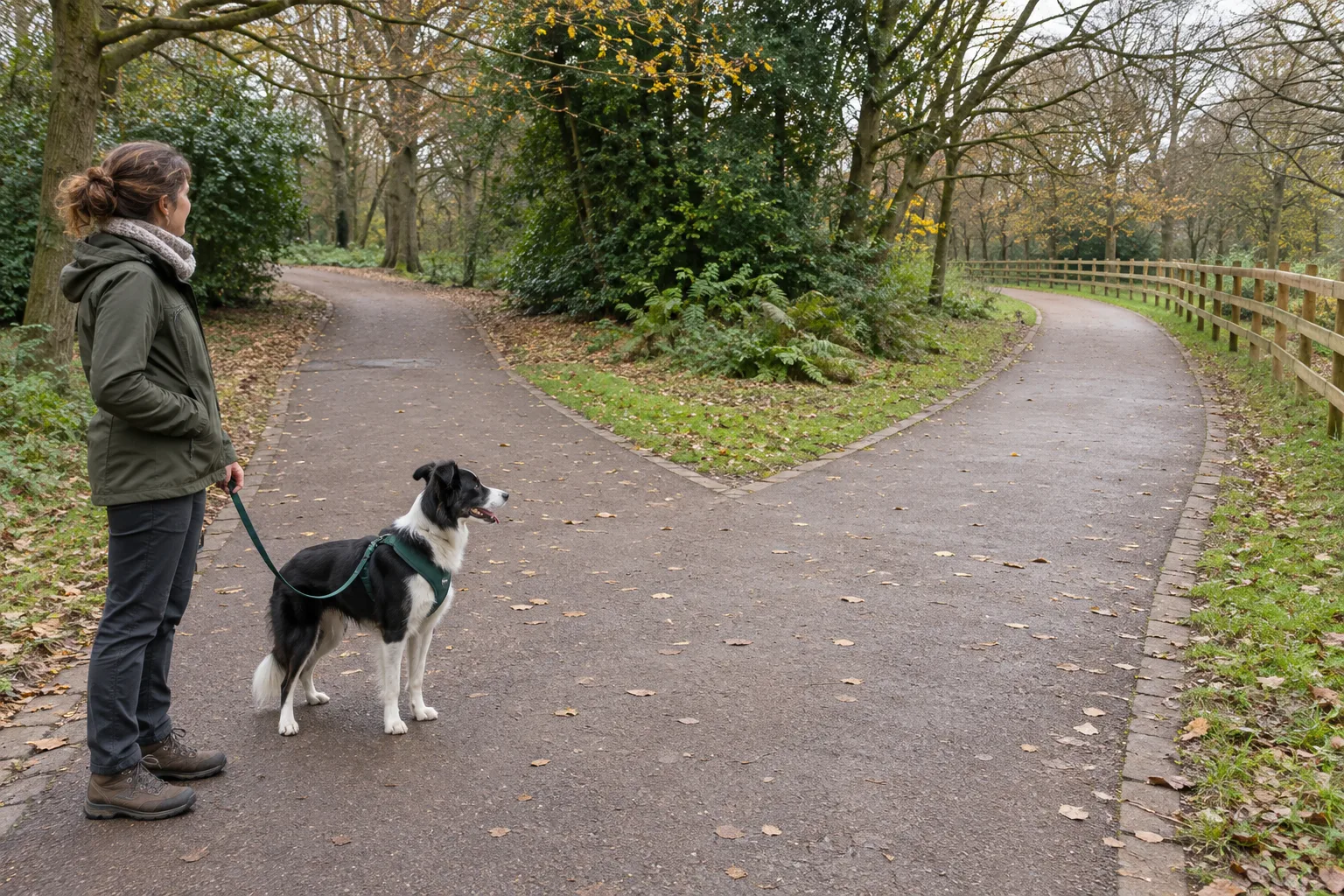
Rehearse your turn on a quiet path
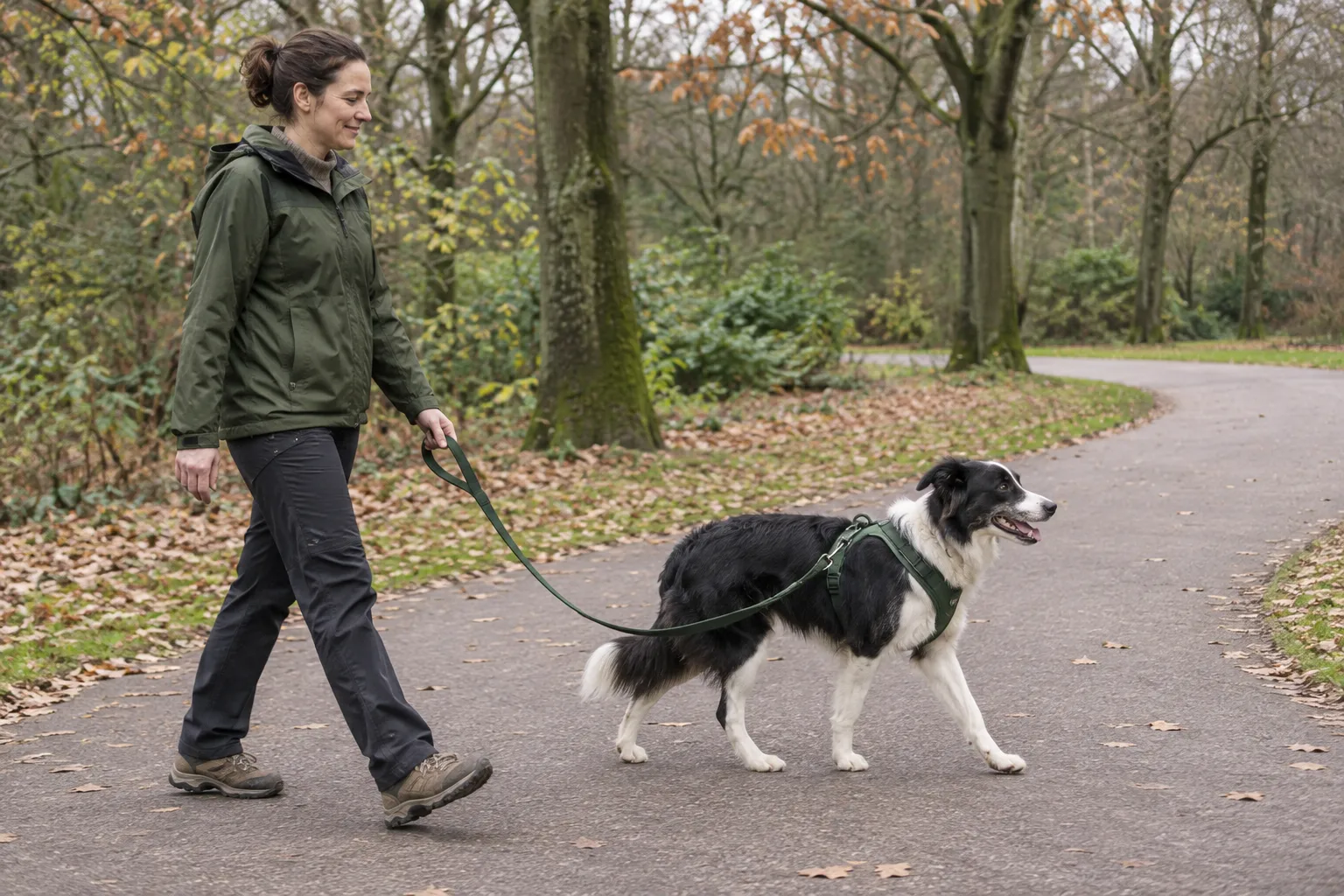
Choose a level place with room to turn and no nearby barking. Walk as you normally would with your dog beside you. Slow a little, say the short phrase you want to use and make a wide curve away from your original direction. Use the same gentle pace through the turn. Reward your dog beside you after they have changed direction and there is space to stop. Our reward marker guide explains how a familiar marker can help you identify the moment they turn.
Follow the curve your dog can take easily. A sharp pivot can put the lead across your dog's path, especially if you are both on different sides of a narrow walkway. If your dog comes round late, enlarge your curve and begin from a slower walk next time. The cue should tell them what you are about to do. Leave the lead loose enough for comfortable movement while retaining safe control. Never try the exercise off lead near a fence or road.
Try two easy turns and then let your dog continue the walk. The guide to short training sessions describes how to stop while a repetition is still manageable. On another day you might change the direction you turn, but keep the rest of the setup familiar. If the lead tightens, you are still working on the foundation. Wait before adding anyone else, unfamiliar places or louder activity.
Leave early when a bark interrupts the walk
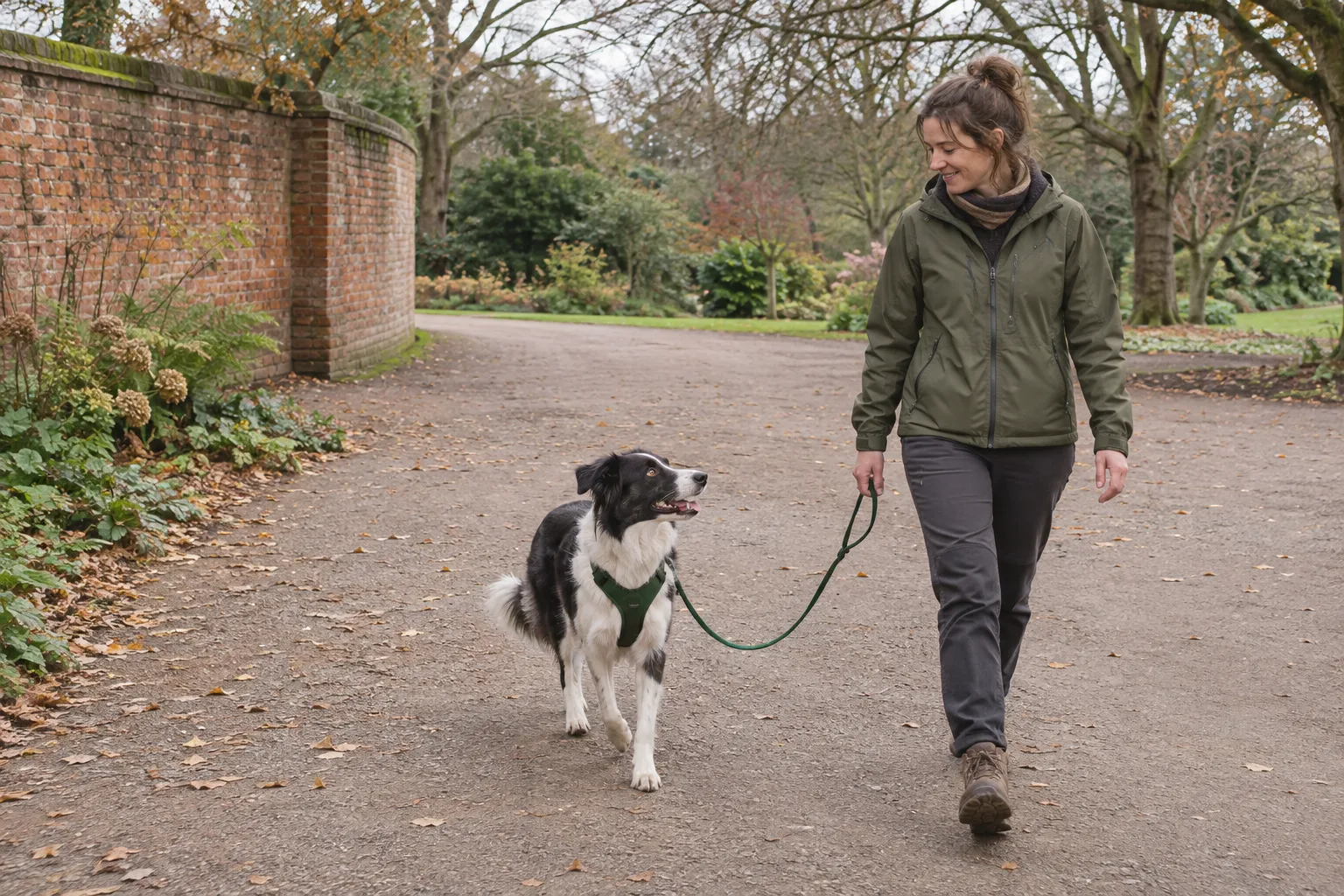
Imagine you are approaching a wall and a single bark comes from behind it. If you still have room, take the wide turn you practised, then carry on toward quieter space. If there is a person close behind, ask for a little room before you turn. Keep clear of property access and of the road. A passing driver or cyclist may not be able to react if you step out. Once you are away, give your dog time to look around and choose whether to sniff, walk or pause.
If your dog freezes, avoid repeated commands or a pull on the lead. Allow a moment as long as the location is safe. Turn your shoulders toward the open route and give them space to move with you. If there is a risk of contact, a damaged fence or a dog that might escape, prioritise leaving safely and never attempt to inspect the fence with your dog. Avoid that section on future walks.
A quiet dog is not necessarily ready to go closer. Look at the whole walk after the turn. Did ordinary sniffing return? Was the stride still quick and stiff for another block? Could your dog take the familiar route home comfortably? Use those answers to decide whether to end the walk or continue somewhere easier. You can reward a voluntary look away from the fence where your dog is comfortable, while you still have room to leave promptly.
Use DogPath to organise only the foundation
Dog Train Club and DogPath share a publisher. In DogPath, choose a relevant foundation lesson such as nearby attention or walking together. Read its preparation and prerequisites before deciding what you will practise. You can pair an exercise you already know with the calm turn on a broad path. Keep the real-world objective simple: your dog follows a change of direction on ordinary ground before either of you has to manage a barking fence.
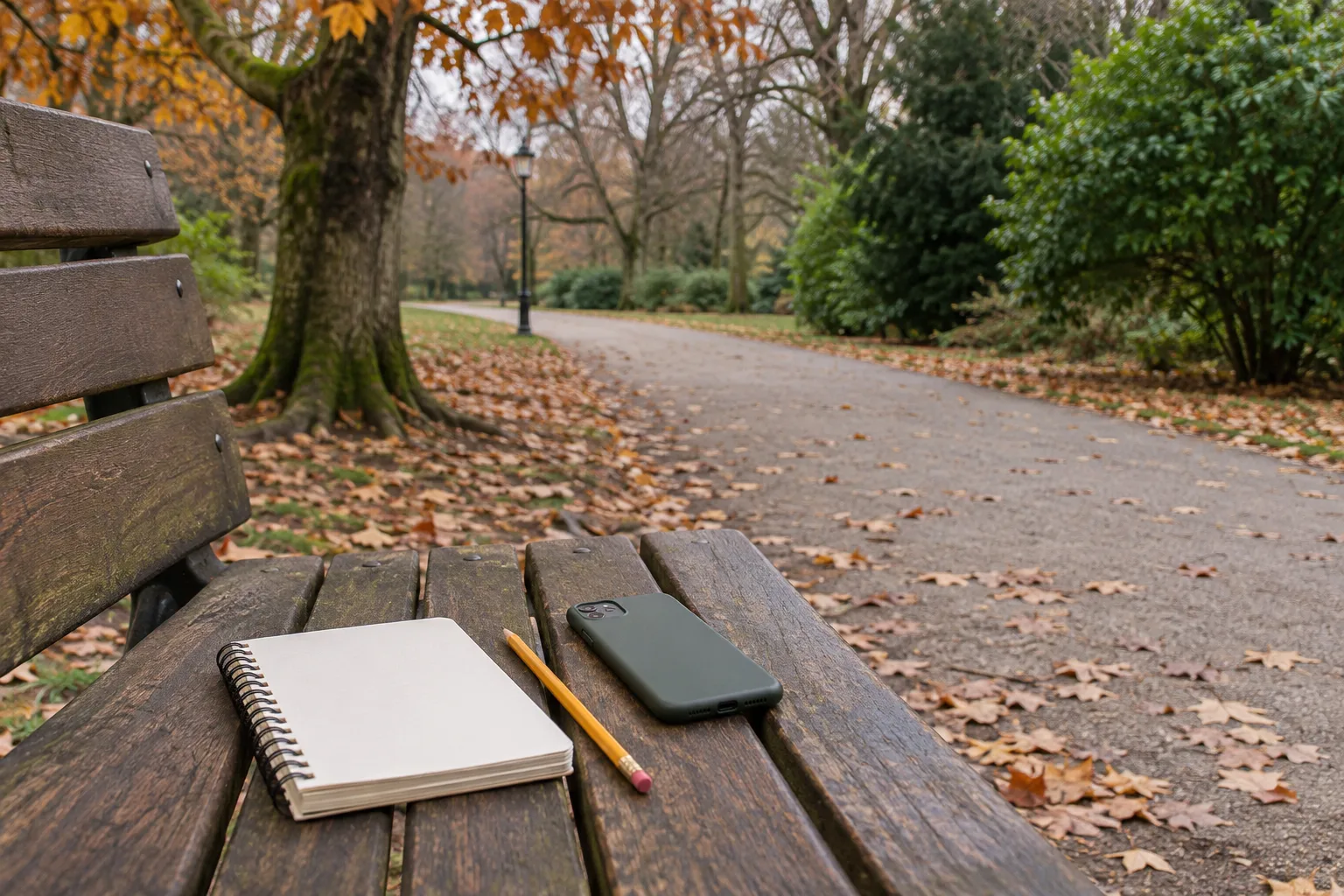
Put brief foundation practice in the app's weekly plan and record the sessions you actually complete. Keep route notes separately. A useful line might say: Tuesday, heard two barks at the corner, turned at the path junction, ordinary sniffing resumed before we reached the bench. Write the observation after the walk when you can pay attention to the notebook or phone safely. A map reference is often more useful than an estimated distance.
Review your observations after several ordinary walks. If the dog has started slowing down earlier, make the avoiding route your default and ask for qualified reward-based help in person. If fear is sudden, your dog moves differently, you suspect pain or someone might be bitten, seek in-person veterinary guidance and keep away from the trigger. The app can organise a foundation and record practice. The choice to return to the street depends on the dog and on a safe plan that takes the actual surroundings into account.
Common questions
Does my dog have to pass the gate eventually?
No. A comfortable alternative that works for everyday walks can be your regular route. You can practise turns elsewhere because the movement is useful in many places. Avoid arranging visits to the gate just to measure progress.
What if the barking starts after we've almost passed?
Pick the safe exit that requires the least time near the fence. Continuing toward open space may be easier if you are already past most of the boundary. Turning is useful when it increases distance without taking you into traffic or across another person's path. Decide from the layout rather than from a fixed rule.
Should I ask the neighbour to bring their dog out?
A close introduction adds pressure and is outside this plan. If a loose dog is a risk, keep your dog away and take any property or safety concern up separately. A qualified professional can help plan suitable practice without involving an uncontrolled encounter.